
Chemical Pumps: Why They Fail and How to Prevent Repeat Failures
Chemical pumps usually fail because the equipment was selected without fully verifying the chemistry, concentration, temperature, specific gravity, hydraulics, duty cycle, and protection strategy. This guide explains the failure mechanisms that matter most and the specification decisions that stop the same failure from repeating.
The Same Pump Keeps Failing, but the Replacement Does Not Fix the Cause
This guide applies when the pump is being replaced repeatedly, the motor runs but flow disappears, or the failure changes with chemical concentration, heat, tank level, or operating condition.
Quick answer: replacing the pump without correcting the material, hydraulic, or protection error usually repeats the failure. The specification must be rebuilt around actual service conditions.
The Pump Was Rarely the Whole Problem. The Specification Was.
Industrial facilities often replace the same pump three, four, or five times before anyone asks why the failure keeps returning.
In sodium hypochlorite feed systems, hydrochloric acid transfer lines, sulfuric acid service, plating processes, and industrial wastewater systems, the visible failure may be a leaking connection, damaged bushing, deformed impeller, loss of prime, or zero-flow event. Those symptoms do not identify the root cause by themselves.
The root cause may be incompatible wetted materials, a motor sized for water instead of the actual specific gravity, insufficient NPSH available, suction lift applied to a flooded-suction pump, dead-head operation, dry running, solids blockage, or a missing power-monitor trip.
Engineering certainty starts with verifying the complete wetted path — housing, impeller, O-rings, shaft, bushing, pipe, fittings, valves, and instrumentation — against the real service conditions before the order is placed.

Polypropylene vs PVDF: The Decision That Controls Chemical Pump Service Life
Polypropylene and PVDF are common construction materials for sealless plastic chemical pumps. They overlap in some services, but they are not automatically interchangeable.
Polypropylene (PP)
Family-level temperature reference: up to 180°F (82°C) on Finish Thompson DB/SP series- Commonly selected for many corrosive fluids where the exact grade and manufacturer rating support the service.
- Can be a valid choice for selected acids, caustics, and sodium hypochlorite applications when concentration, temperature, and resin formulation are verified.
- Provides a lower material cost than PVDF in many pump configurations.
- Offers less universal temperature and oxidizer margin than PVDF across aggressive service conditions.
- Must be checked against the exact chemical and the specific pump manufacturer’s resistance data.
PVDF — Polyvinylidene Fluoride
Family-level temperature reference: up to 220°F (104°C) on Finish Thompson DB/SP series- Commonly selected where aggressive oxidizers, elevated temperature, UV exposure, or broader chemical resistance margins are present.
- Often considered for concentrated acids, chlorine-bearing service, and demanding outdoor installations.
- Provides higher temperature capability than polypropylene in the same DB/SP pump families.
- Costs more than polypropylene but may reduce replacement risk when the service envelope demands it.
- Still requires manufacturer verification at the actual concentration and temperature.
Elastomer Selection Is the Hidden Failure Point
Housing material alone does not complete the specification. O-rings and other elastomers may be EPDM, FKM, FFKM, FEP-encapsulated, or another formulation. Compatibility varies with concentration, temperature, chemical purity, compression, cycling, and manufacturer formulation. Never replace one elastomer with another from a generic chart alone.
Sodium Hypochlorite Material Screening
This table is intentionally conservative. It identifies common candidates and required checks; it does not approve a final specification.
| Material / Component | Screening Status | What Must Be Verified |
|---|---|---|
| PVDF | Common Candidate | Concentration, temperature, stress, connection design, and manufacturer rating |
| Unfilled Polypropylene | Common Candidate | Resin grade, chemical strength, temperature, UV exposure, and pump-specific data |
| ETFE / PTFE | Common Candidate | Component construction, mechanical limits, permeation, and installation method |
| 316 Stainless Steel | High-Risk Choice | Do not assume compatibility; obtain chemical-supplier and manufacturer confirmation |
| EPDM Elastomer | Verify Formulation | Concentration, temperature, oxidizer exposure, compression, and manufacturer compound |
| FKM / FFKM Elastomer | Verify Formulation | Exact chemical strength, temperature, compound grade, and seal geometry |
34 Months of Uninterrupted Runtime After One Specification Correction
A municipal water treatment facility operating at 3.2 MGD was replacing a sodium hypochlorite pump every six to eight weeks. The recurring failure was treated as a pump problem until the material specification was reviewed against actual service conditions.
System Conditions at Time of Failure
| Chemical | Sodium hypochlorite, 12 percent concentration |
| Ambient | Approximately 100°F |
| Duty Cycle | Continuous |
| Original Construction | Polypropylene housing with an elastomer configuration that had not been fully verified for the service |
| Root Cause | Material selection was not confirmed against the actual concentration and temperature |
| Correction | PVDF construction with a manufacturer-verified elastomer package |
The pump was not treated as a defective product. The specification was corrected. The cost of the fix was less than another emergency replacement cycle.
View LibertyCES Case Studies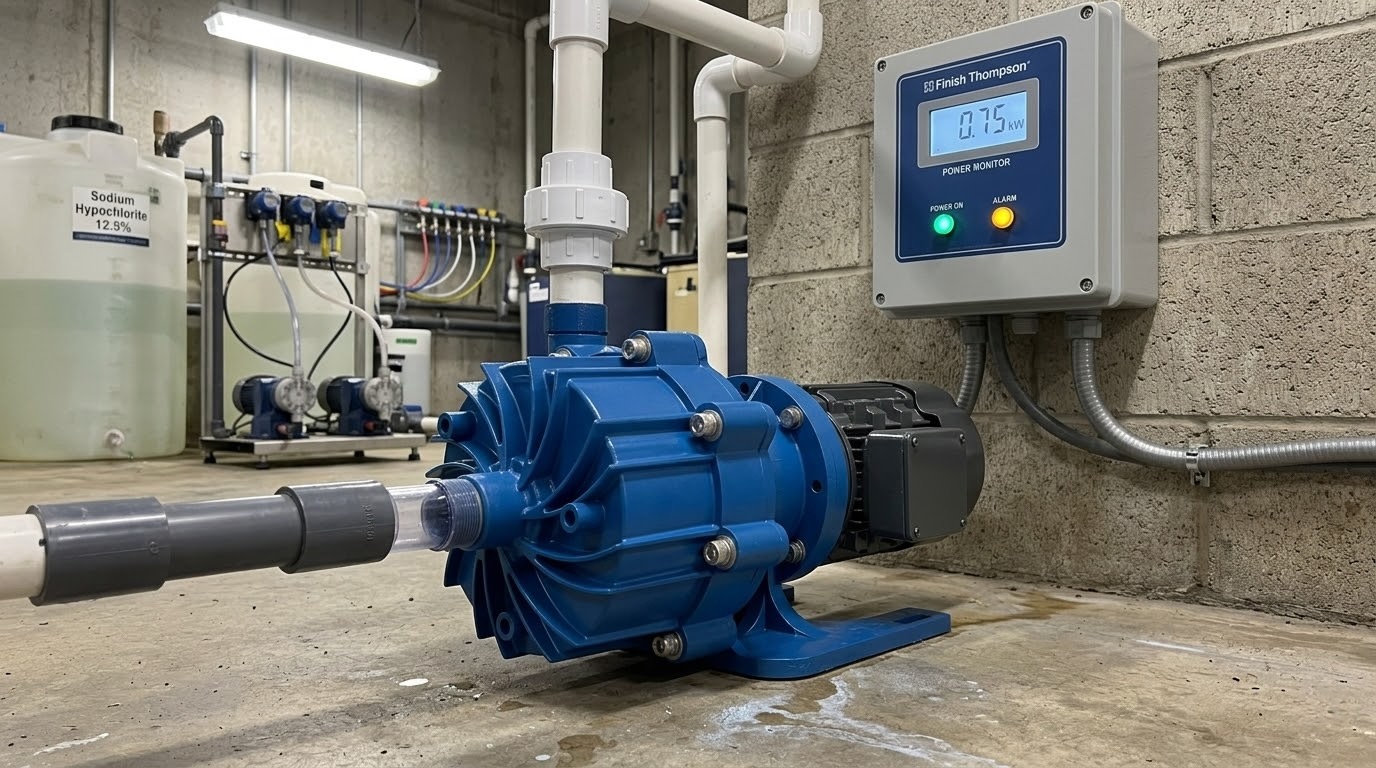
Mag-Drive Decoupling: The Failure That Looks Like a Running Pump With No Flow
What Decoupling Actually Is
Sealless magnetic-drive pumps transmit motor torque through a containment shell using an outer drive magnet and an inner driven magnet connected to the impeller. No rotating shaft penetrates the rear casing, which removes the mechanical shaft seal as a leak path.
Decoupling occurs when the torque required by the impeller exceeds the magnetic coupling’s pull-out capability. The outer drive continues to rotate, but the driven magnet and impeller slow, stall, or stop. The motor sounds as though it is running while fluid delivery disappears.

Four Conditions That Can Trigger Decoupling
- Specific gravity or viscosity above the selected duty. Higher-density or more viscous fluid increases required power and coupling torque. Motor and magnet selection must be checked against the actual fluid, not water.
- Dead-head or severe discharge restriction. A closed valve, fouled filter, or blocked line can drive the pump outside its safe operating condition and create damaging heat.
- Solids or crystallized material at the impeller. Entrained particles can cause an abrupt torque spike, stall the impeller, or damage the bushing system.
- Rapid process change. Batch changeover, concentration shift, or temperature change can move the fluid outside the conditions used for the original selection.
Detect the Event Before Heat and Wear Cause Damage
A properly configured power monitor can watch motor load for both minimum-power and maximum-power conditions. A sharp drop may indicate dry running or decoupling; a high-power event may indicate overload, blockage, or another upset. Alarm thresholds must be commissioned against the actual loaded operating point.
Select the Chemical Pump Series From the Installation, Duty Point, and Fluid
Finish Thompson DB, SP, and MSDB families cover different installation and hydraulic requirements. A series name is not a final selection; the model and motor must be confirmed on the performance curve at the actual service condition.
DB Series
General-purpose sealless transfer where the pump has positive inlet head
Bulk chemical transfer, circulation, filtration, fume scrubbing, water treatment, plating, and process feed.
SP Series
Used when the pump must lift fluid from below its centerline
Sumps, below-grade tanks, rail cars, tanker trucks, over-the-wall transfer, and systems with entrained air.
MSDB Series
Multi-stage sealless design for higher head at lower flow
High-restriction filtration, spray systems, chemical delivery into pressurized processes, and other high-head duties.
Family-level values are provided for screening. Final flow, head, specific gravity, viscosity, lift, motor, impeller, and material selection must be confirmed against the current manufacturer curve and service data.
Common Chemical Pump Failure Modes and the Correct Engineering Response
Each failure presents differently. Correct diagnosis determines whether the solution is a part replacement, an operating change, a control upgrade, or a complete specification correction.
| Failure Mode | Likely Root Cause | Operational Signs | Engineering Response |
|---|---|---|---|
| Cavitation | NPSH available below the pump requirement | Crackling noise, reduced flow, vibration, impeller erosion | Reduce suction loss, increase liquid head, lower temperature where possible, reselect the pump, or use self-priming architecture when lift is unavoidable |
| Dry Running | Empty tank, closed suction valve, air lock, lost prime | Zero flow, low motor load, rapid bushing or containment damage | Add minimum-power trip, low-level shutdown, valve permissives, and a pump configuration appropriate for the dry-run risk |
| Mag-Drive Decoupling | Excess torque from SG, viscosity, blockage, or process upset | Motor runs, flow stops, motor load changes, rear casing may heat | Verify fluid properties and coupling selection; add power monitoring and prevent dead-head or blockage conditions |
| Elastomer Damage | Wrong compound, temperature, concentration, or compression condition | Leakage, swelling, hardening, cracking, loss of sealing force | Verify the exact compound with the pump manufacturer and chemical supplier at actual service conditions |
| Material Degradation | Housing, impeller, shaft, bushing, or piping material outside its chemical envelope | Discoloration, distortion, cracking, erosion, progressive loss of performance | Review the complete wetted path; upgrade the specific materials that fail the compatibility review |
| Off-BEP Operation | Operating point too far from the selected pump’s efficient region | Noise, vibration, heat, recirculation, accelerated wear | Reselect the pump, trim the impeller, adjust system resistance, or use speed control with defined minimum-flow protection |
A symptom does not prove a root cause. Field readings, inspection evidence, hydraulic calculations, and material verification should agree before the corrective specification is released.
Eight Questions That Must Be Answered Before Any Chemical Pump Is Ordered
These questions create the engineering basis for the specification. Missing one can create the exact failure the replacement was supposed to solve.
What is the exact chemical, concentration, blend, and known impurity profile?
What are the normal and maximum fluid temperatures, plus the ambient range?
What are the specific gravity and viscosity at operating temperature?
What flow is required at normal demand, minimum demand, and maximum demand?
What is the total dynamic head, including elevation, friction, filters, valves, and downstream pressure?
What is the NPSH available at minimum tank level, maximum flow, and maximum temperature?
Is the duty continuous, intermittent, or batch, and what dry-run or dead-head exposure exists?
What containment, controls, alarms, interlocks, and regulatory requirements apply?
Chemical Pumps: Selection, Failure Diagnosis, and Prevention
Why does a sodium hypochlorite chemical pump keep failing?
What is the difference between polypropylene and PVDF chemical pumps?
How can I tell whether a magnetic-drive chemical pump is decoupling?
When should the SP Series be used instead of the DB Series?
Does a sealless chemical pump eliminate every leak risk?
What is the best way to protect a chemical pump from dry running?
How does specific gravity affect chemical pump selection?
What chemical pump should be used for concentrated sulfuric acid?
Get a Verified Chemical Pump Specification Before the Next Order
LibertyCES reviews the chemistry, concentration, temperature, fluid properties, system hydraulics, materials, controls, and failure history before a replacement or new chemical pump is released.
Stop replacing symptoms. Correct the failure mechanism.
Send the chemical, concentration, temperature, pressure, flow, pump location, current materials, failure symptoms, and photographs.
james@libertyces.com