
Engineered to eliminate failure — not just ship equipment
LibertyCES specs pumps, valves, tanks, filtration, and chemical feed systems against your real process conditions — chemistry, concentration, temperature, flow, and pressure — not a part number pulled off a page.
CPUC Supplier Clearinghouse Certified MBE · California Certified Small Business
What's your setup actually costing you if it's wrong?
Answer two quick questions about your application and we'll show you the specific things that determine whether your current setup is safe, compliant, and built to last — then send it straight to your inbox.
Engineered systems, organized by what they do
Every category is backed by real sector applications and chemical-compatibility data, sourced to named vendor documentation.

Diaphragm, peristaltic, metering, drum, sealless, and slurry pumps.
Wetted materials matched to your fluid — not a generic GPM rating.

Ball, butterfly, gate, plug, check, and thermoplastic valve lines.
Body/seat material specced per chemical service, PVC to PVDF to exotic alloy.

Flow meters, level/pressure instruments, analyzers, SCADA integration.
Sensor chemistry matched to your actual pH/ORP/turbidity range.

Cartridge/bag filtration, RO/UF/EDI, softening, UV disinfection.
Sized to your real micron rating and flow rate, not a stock cartridge.

Thermoplastic piping, fluoropolymer tubing, fittings, chemical hose.
Selected for your chemical concentration, temperature, and pressure class.

Chemical scrubbers, biofilters, carbon adsorbers, FRP ductwork/stacks.
Sized to your actual CFM and H2S/VOC loading, not a catalog default.

Chemical feed skids, mixers/agitators, metering and injection systems.
Engineered for your viscosity and mix ratio, not a one-size skid.

Chemical storage, brine, dual-containment, and bulk storage tanks.
Specified per chemical: single-wall, dual-containment, or SAFE-Tank.

Meter-mix proportioners, hot-melt systems, automated dispensing cells.
Matched to your material's cure profile and viscosity, not a generic gun.

Every system on this site runs in a real plant, on a real process, right now.
Precision pH Control: 24% Savings & Zero Compliance Violations
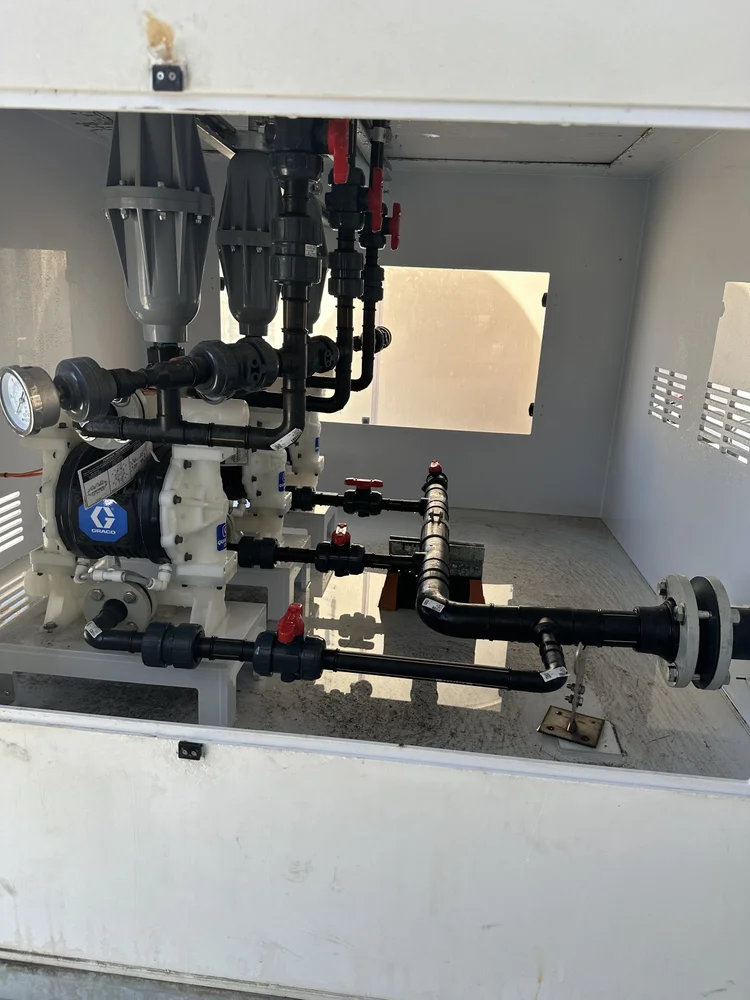
Operators were flying blind without real-time feedback. Manual dosing was generating 18–25% chemical waste and putting Title 22 compliance at risk on 50% H₂SO₄ and 45% KOH. LibertyCES designed a closed-loop PLC system — the plant has never overshot again.
“Operators were flying blind. Our closed-loop PLC and inline sensors eliminated overshoot forever.”
| Challenge Fixed | LibertyCES Outcome |
|---|---|
| Manual dosing — 18–25% chemical waste | 24% savings via PLC + electric pumps |
| pH overshoot & Title 22 compliance risk | Zero violations, real-time closed-loop feedback |
| Fouled probes, sensor guesswork | 2× sensor life, full SCADA integration |
| Production disruption at 125K GPD | Uninterrupted operation since installation |
Results documented post-installation at a major U.S. cheese processing facility.
Guides, industries, manufacturers, and solutions

69 in-depth spec and failure-analysis guides, free to read online — no download or email required.
The same guides as PDFs, plus case studies and vendor catalogs — save, print, or share offline.

Municipal water & wastewater, mining, chemical processing, agriculture, and industrial process water.

The real vendors LibertyCES specifies — pumps, valves, tanks, filtration, and instrumentation.

Find the right system by application, not by part number — organized around what you're trying to solve.

James Riggins. The Guy Who Answers the Phone.
With 30+ years in the field, I know that "standard" parts fail in "custom" situations. I founded LibertyCES to be the engineering partner I wish I had: responsive, technically rigorous, and completely honest about what a system needs to run.
No sales team. No hold queue. When you call the LibertyCES engineering line, you get me — and a real answer.
“We don't just drop boxes and wish you luck. We design for uptime, clarity, and peace of mind.”
Frequently Asked Questions
What does LibertyCES do?
LibertyCES (Liberty Chemical Equipment & Supply Inc.) is a spec-first industrial equipment engineering company — pumps, valves, tanks, filtration, piping, instrumentation, and chemical feed systems for municipal water/wastewater, mining, chemical processing, agriculture, and industrial process water. Equipment is matched to your actual fluid, concentration, temperature, and duty cycle, not sold by generic catalog spec.
How is LibertyCES different from a catalog distributor?
A catalog distributor sells by part number. LibertyCES reviews the real process data — fluid, chemistry, concentration, temperature, flow, pressure, and current equipment — before recommending anything, with 30+ years of field experience and zero specification failures across 100+ municipal and industrial projects.
Does LibertyCES only sell to large facilities, or can smaller operations get a spec review?
A free spec review is available for any project size — municipal, industrial, or agricultural. The intake process is the same regardless of scale: send the real process conditions and get back an actual engineered recommendation, not a sales pitch.
Is LibertyCES a certified minority-owned or small business supplier?
Yes. Liberty Chemical Equipment & Supply Inc. is a CPUC Supplier Clearinghouse Certified Minority Business Enterprise (MBE) under California Public Utilities Commission General Order 156 (VON 26001569, valid through September 22, 2029) and a California Certified Small Business (Micro) through the Department of General Services (Cert. ID 2028632). Utilities, prime contractors, and procurement teams that track supplier-diversity or small-business spend can request the certificates and a full vendor packet.
What industries does LibertyCES serve?
Municipal water and wastewater treatment, mining, chemical processing, food & beverage, agriculture/irrigation, and industrial process water filtration — each with dedicated technical content built around that industry's specific chemistry and compliance requirements.
Send LibertyCES the process data, not a part number
Fluid, chemistry, concentration, temperature, flow, pressure, and current equipment — that's what a real spec review needs to start.
Reviewed by James Riggins, 30+ years specifying water and chemical process equipment · Updated