PTFE Diaphragms for Chemical Processing
When PTFE is right, and when composite construction matters. PTFE diaphragms are used in aggressive chemical valve service because the PTFE face provides broad chemical resistance — but the final valve spec depends on more than the wetted surface.
30+ years spec experience. Send James the process data and get a real answer — not a catalog page.
Request a Spec Review →PTFE protects against chemical attack. The diaphragm construction determines whether the valve actually cycles, seals, and survives.
Backing material, body material, temperature, pressure, permeation, off-gassing, and diaphragm construction all determine whether the valve survives. Chemical resistance charts are screening tools, not final approvals.
What Is a PTFE Diaphragm?
A PTFE diaphragm is a valve diaphragm with a PTFE wetted face. The PTFE layer contacts the chemical media, while the backing material provides the mechanical elasticity needed for sealing and cycling. In many chemical processing valves, the diaphragm is not just one material — it may be a bonded or layered construction combining chemical resistance, elastomer flexibility, gas-barrier performance, and mechanical support.
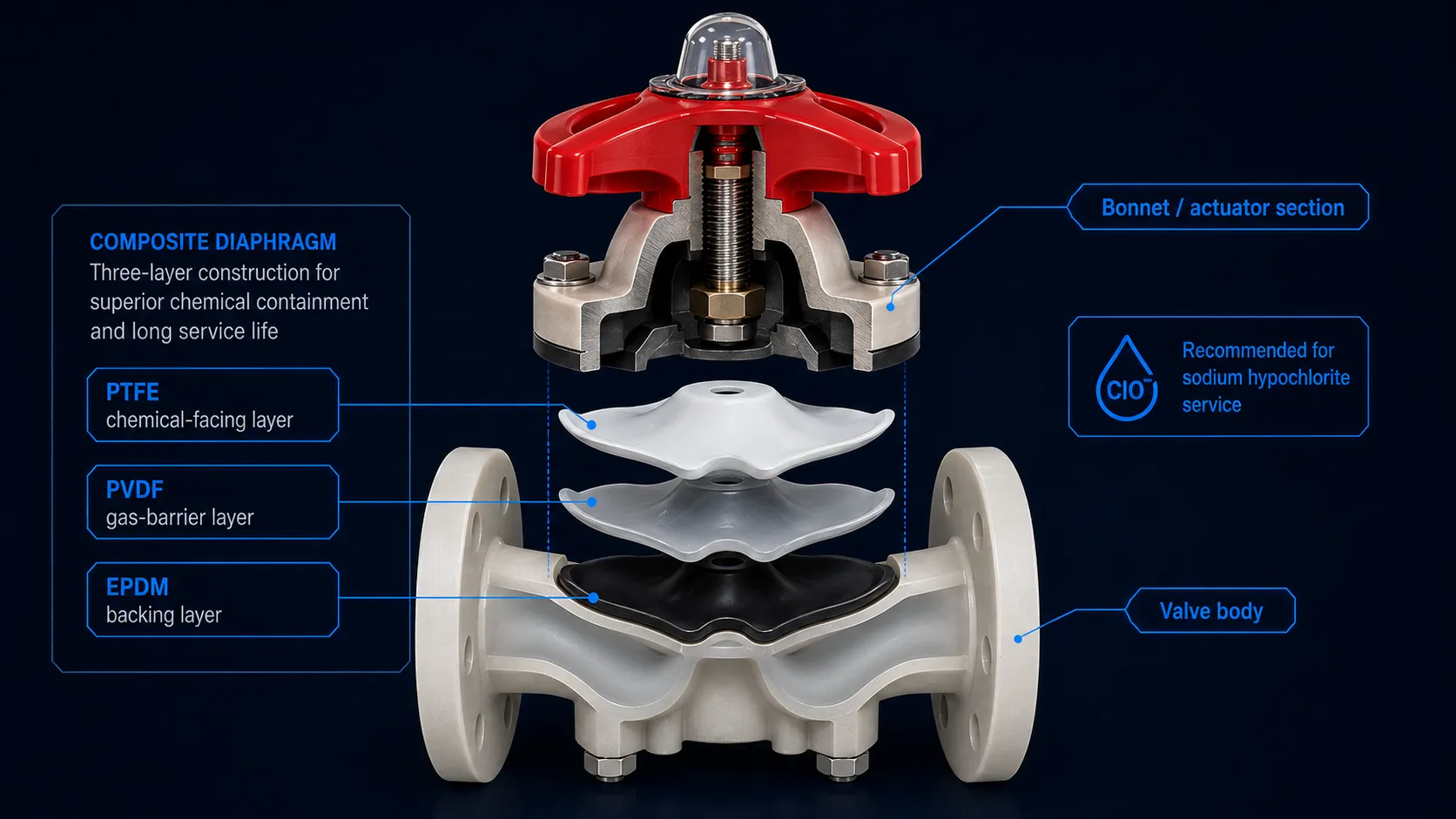
PTFE Face
The chemical-facing barrier — selected when the chemical would attack, swell, soften, or degrade a standard elastomer diaphragm.
Backing Layer
Provides mechanical support. Helps the diaphragm flex, compress, recover, and seal during valve cycling.
PVDF Barrier Layer
In certain composite diaphragms, a PVDF layer can act as a gas-barrier for aggressive off-gassing service such as sodium hypochlorite or wet chlorine exposure.
Valve Body Context
The diaphragm cannot solve the whole application by itself. Body material, seat geometry, actuation, pressure, and temperature still define the final valve spec.
Why PTFE Is Used in Chemical Processing Valves
1. Broad Chemical Resistance
PTFE resists a wide range of aggressive chemicals — valuable in chemical processing, water treatment, bleach systems, acid service, and high-purity systems where standard elastomers may swell, crack, soften, or degrade.
2. Low Contamination Risk
PTFE is often selected where the media cannot tolerate contamination from elastomer extraction or leaching — common in high-purity and corrosive chemical systems.
3. Aggressive Acid & Oxidizer Fit
PTFE diaphragms can be a strong fit for aggressive chemical media, but the exact construction still matters — PTFE-backed and PTFE-composite grades are not interchangeable.
4. Better Barrier Than Many Elastomers
PTFE is a fluoropolymer barrier, not an elastomer. It resists chemicals that would attack standard rubber diaphragms, but may still need a backing layer to flex and seal properly.
Where PTFE Diaphragms Can Still Fail
PTFE is a strong chemical barrier, but it is not magic. In valve service, failure often comes from the interaction between chemical exposure, mechanical cycling, compression, temperature, body material, and off-gassing. Permeation: aggressive media and gases can still create permeation concerns — in off-gassing service, that can expose bonnet internals to attack. Creep and Compression Set: PTFE can deform under sustained load, affecting long-term seal integrity.

PTFE Diaphragm FAQ
What is a PTFE diaphragm used for?
A PTFE diaphragm is used when the wetted valve surface needs high chemical resistance against aggressive acids, oxidizers, solvents, or high-purity chemicals. PTFE usually acts as the chemical barrier, while another material behind it provides flexibility, compression, and mechanical support.
Is PTFE always the right diaphragm choice for aggressive chemicals?
No. PTFE is a strong chemical barrier but not a catch-all — permeation, creep, and compression set can still cause failure depending on mechanical cycling, compression, temperature, body material, and off-gassing conditions.
What is a PVDF barrier layer used for in composite diaphragms?
A PVDF layer can act as a gas-barrier in composite diaphragm construction for aggressive off-gassing service, such as sodium hypochlorite or wet chlorine exposure, protecting bonnet internals from vapor attack.
How is PTFE different from EPDM or FKM?
EPDM and FKM are elastomers; PTFE is a fluoropolymer barrier. PTFE can resist chemicals that would attack standard rubber diaphragms, but it may still need a backing layer to flex and seal properly during valve cycling.
Not sure whether your valve needs PTFE, EPDM, FKM, or a composite diaphragm?
Send the chemical, concentration, temperature, pressure, valve type, body material, and seal details.