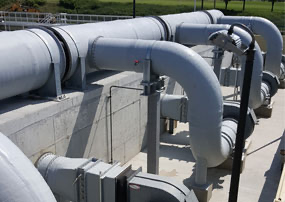
Ductwork — Acids
30+ years spec experience. Send James the process data and get a real answer — not a catalog page.
Request a Spec Review →Named chemicals
LibertyCES has documented Ductwork in Acids service, including Hydrochloric Acid. Wetted materials to confirm: Polypropylene and HDPE. Documented models include Houston PolyTank PP/HDPE Ductwork and Perry Fiberglass FRP Ductwork. Compatibility depends on exact concentration, temperature and duty cycle, so confirm with a free spec review.
Notes from the vendor documentation
Independently confirms the project's hcl-vapor-no-metal rule via explicit 'chemical fume extraction'/'laboratory hood exhaust' PP ductwork applications.
Materials documented for this service
- Polypropylene (preferred over metal)
- HDPE
Products cited for this service
Real Specifications
| Spec | Value | Source document |
|---|---|---|
| Named PP ductwork applications | Industrial exhaust systems, chemical fume extraction, shop floor/process ventilation, laboratory hood exhaust, hazardous particulate conveyance, tank venting systems | Houston PolyTank — Website (Applications, Industries, Accessories) |
| Case study material spec | Custom high-impact polypropylene (PP) packed-bed wet scrubber for HCl vapor control, with chemical-resistant PP ducting | LibertyCES field case study: California HCL Fume Scrubber |
| Engineering rule (verbatim) | "Polypropylene is commonly selected for hydrochloric acid fume control because it resists corrosion better than many metals in acid vapor service." | LibertyCES field case study: California HCL Fume Scrubber |
| FRP duct diameter range | 2" – 168" round (rectangular sized to project) | Perry Fiberglass Products |
| FRP duct standard length | Up to 40' standard lengths (up to 50' per marketing copy) | Perry Fiberglass Products |
Corrosion escalation — HCl fumes degrading ducting, valves, and metal assets — was the plant's core pre-scrubber problem in the case study; PP or FRP ducting instead of metal is specified precisely to eliminate that failure mode in acid-vapor service.
Metal ductwork corrodes in acid-vapor service — the California plant in Liberty CES's own HCl case study was losing ducting, valves, and metal assets to exactly that failure before the switch to PP construction. Houston PolyTank's own applications list (chemical fume extraction, laboratory hood exhaust) independently confirms polypropylene, not metal, is what acid-vapor duct runs actually require.
Every material and product claim on this page traces to real, vendor-published documentation on file with LibertyCES. Chemical compatibility depends on exact concentration, temperature, and duty cycle — confirm current specifications with the manufacturer and request a spec review before final specification.
FAQ
Can Ductwork handle Acids?
Independently confirms the project's hcl-vapor-no-metal rule via explicit 'chemical fume extraction'/'laboratory hood exhaust' PP ductwork applications.
What wetted materials should Ductwork use in Acids service?
Materials documented for this service: Polypropylene (preferred over metal), HDPE. Compatibility depends on exact concentration, temperature and duty cycle, so confirm with a spec review before final specification.
Which Acids chemicals does this cover?
Named chemicals in this documentation: Hydrochloric Acid (fume/vapor).
Which Ductwork models are documented for Acids?
Documented examples include Houston PolyTank PP/HDPE Ductwork, LibertyCES HCl fume scrubber case study ducting, Perry Fiberglass FRP Ductwork.
Ready to buy or need a fast answer? Call, text, or email James directly — (559) 395-5500 · [email protected].
Send James your spec
Fluid, concentration, temperature, flow or volume, and where it goes. James replies with a real answer, not a catalog page.
Reviewed by James Riggins, 30+ years specifying water and chemical process equipment · Updated