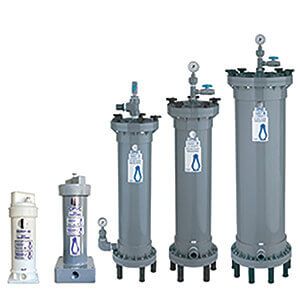
Media Filtration System — Water/Aqueous
30+ years spec experience. Send James the process data and get a real answer — not a catalog page.
Request a Spec Review →Named chemicals
LibertyCES has documented Media Filtration System in Water/Aqueous service, including chlorine, chloramines and iron. Wetted materials to confirm: Fiberglass tanks, Clack 1191 control valve and ISO 9001. Documented models include AXEON AC-Series and AXEON CC-Series. Compatibility depends on exact concentration, temperature and duty cycle, so confirm with a free spec review.
Materials documented for this service
- Fiberglass tanks
- Clack 1191 control valve (Upflow Carbon) vs an unnamed 'Advanced' control valve on AC/CC/ZE
- NSF/ANSI 61 certified components
- ISO 9001:2015 manufacturing
Products cited for this service
Real Specifications
| Spec | Value | Source document |
|---|---|---|
| AC-Series vs CC-Series distinction | AC-Series (activated coconut shell carbon) removes chlorine, heavy metals, organics; CC-Series (catalytic carbon) specifically targets chlorine plus chloramines, which standard activated carbon handles poorly | AXEON Water Technologies — Filtration, Ion Exchange, Disinfection & Injection Systems |
| ZE-Series zeolite media | Sediment/debris removal down to 5 microns, high flow rates, pre-filtration duty | AXEON Water Technologies — Filtration, Ion Exchange, Disinfection & Injection Systems |
| Control valve distinction | Clack 1191 control valve used specifically on the Upflow Carbon line vs. an unnamed 'Advanced' control valve on AC/CC/ZE | AXEON Water Technologies — Filtration, Ion Exchange, Disinfection & Injection Systems |
| Certifications | NSF/ANSI 61 certified components, ISO 9001:2015 manufacturing | AXEON Water Technologies — Filtration, Ion Exchange, Disinfection & Injection Systems |
Standard activated carbon (AC-Series) handles chloramines poorly, so a municipality that has switched from free-chlorine to chloramine disinfection needs the catalytic carbon CC-Series instead — using AC-Series against chloraminated feedwater is a real, common misspecification.
Chlorine and chloramines look like the same problem — disinfectant in the water — but they need different carbon chemistry. Standard activated carbon handles free chlorine well and chloramines poorly, so specifying by micron rating alone instead of by carbon type is how a plant that switched to chloramine disinfection ends up with a media filter that no longer does its job.
Every material and product claim on this page traces to real, vendor-published documentation on file with LibertyCES. Chemical compatibility depends on exact concentration, temperature, and duty cycle — confirm current specifications with the manufacturer and request a spec review before final specification.
FAQ
Can Media Filtration System handle Water/Aqueous?
LibertyCES has documented Media Filtration System in Water/Aqueous service.
What wetted materials should Media Filtration System use in Water/Aqueous service?
Materials documented for this service: Fiberglass tanks, Clack 1191 control valve (Upflow Carbon) vs an unnamed 'Advanced' control valve on AC/CC/ZE, NSF/ANSI 61 certified components, ISO 9001:2015 manufacturing. Compatibility depends on exact concentration, temperature and duty cycle, so confirm with a spec review before final specification.
Which Water/Aqueous chemicals does this cover?
Named chemicals in this documentation: chlorine, chloramines, iron, manganese, hydrogen sulfide, sediment, heavy metals, organics, pH-depressed water (calcite correction).
Which Media Filtration System models are documented for Water/Aqueous?
Documented examples include AXEON AC-Series (granulated micro-porous coconut shell activated carbon — chlorine, heavy metals, organics), AXEON CC-Series (catalytic carbon — chlorine plus chloramines), AXEON ZE-Series (zeolite — sediment/debris to 5 microns, high flow, pre-filtration), AXEON Upflow Granulated Carbon (NSF/ANSI-certified activated coconut shell carbon, Clack 1191 control valve), AXEON Katalox Iron Treatment Systems, AXEON Upflow Calcite (pH correction/remineralization).
Ready to buy or need a fast answer? Call, text, or email James directly — (559) 395-5500 · [email protected].
Send James your spec
Fluid, concentration, temperature, flow or volume, and where it goes. James replies with a real answer, not a catalog page.
Reviewed by James Riggins, 30+ years specifying water and chemical process equipment · Updated