
EPDM Chemical Compatibility Chart for Valves, Seals, O-Rings, and Diaphragms
EPDM is one of the most common elastomers in water and chemical valve service, but it is not compatible with every chemical. Use this chart to screen EPDM for caustic soda, sodium hypochlorite, dilute acids, potable water, hydrocarbons, oils, fuels, and chemical dosing applications.
What Is EPDM Compatible With?
EPDM is generally strong in water, steam, caustic solutions, many aqueous salts, dilute acids, and many water-treatment chemicals. EPDM is generally weak in petroleum oils, fuels, hydrocarbons, aromatic solvents, chlorinated solvents, and many organic solvents.
For sodium hypochlorite, do not approve EPDM by chemical name alone. Concentration, temperature, off-gassing, valve type, and diaphragm construction matter. Asahi/America describes a sodium hypochlorite diaphragm valve recommendation using a three-layer EPDM/PVDF/PTFE diaphragm with a gas barrier for aggressive off-gassing service.
EPDM Chemical Compatibility Chart
Use this chart as a practical screening tool for EPDM valve seals, O-rings, seats, and diaphragms. The rating should not be treated as a final specification without checking the exact concentration, operating temperature, pressure, and valve construction.

| Chemical / Service | EPDM Compatibility | Practical Spec Note |
|---|---|---|
| Potable water | Good | Common EPDM service. Confirm temperature and approvals. |
| Hot water / steam | Good / Conditional | Strong EPDM category, but verify pressure and temperature limits. |
| Caustic soda / sodium hydroxide | Good / Conditional | Strong in many aqueous caustic services; higher temperatures tighten the envelope. |
| Sodium hypochlorite, low concentration | Conditional | Must verify concentration, temperature, off-gassing, and valve design. |
| Sodium hypochlorite, 12.5% | Limited / Conditional | Do not treat EPDM as automatically approved. Consider composite diaphragm or manufacturer-specific hypo configuration. |
| Ferric chloride | Good / Conditional | Common water-treatment chemical; verify concentration and temperature. |
| Ferric sulfate | Good | Often favorable in aqueous coagulant service. |
| Fluosilicic acid | Conditional | Common fluoride chemical; temperature matters. |
| Phosphoric acid | Good / Conditional | Often usable depending on concentration and temperature. |
| Hydrochloric acid, dilute | Good / Conditional | Higher concentrations and temperature reduce margin. |
| Sulfuric acid, dilute | Good | 10% sulfuric acid is a favorable EPDM screening category. |
| Sulfuric acid, concentrated | Not Recommended | Higher concentrations move into limited or no-resistance territory. |
| Fuel oil | Not Recommended | EPDM is a poor fit for hydrocarbon/oil service. |
| Heptane / hexane | Not Recommended | Hydrocarbon swelling risk. |
| Kerosene | Not Recommended | Hydrocarbon service usually points away from EPDM. |
| Lubricating oils | Not Recommended | Use another elastomer family, often FKM depending on full conditions. |
| Natural gas | Not Recommended | EPDM is generally not the hydrocarbon/gas elastomer choice. |
The table stays intentionally cautious. EPDM is a strong elastomer in many aqueous services, but fuel oil, heptane, hexane, natural gas, kerosene, and lubricating oils usually point away from EPDM.
How to Use an EPDM Compatibility Chart
Do not search the chemical name and stop there. EPDM compatibility depends on six things:
- Chemical name
- Concentration
- Operating temperature
- Pressure
- Valve type
- Which elastomer part is exposed
A valve can have the right body material and the wrong elastomer. A PVC, CPVC, PP, or PVDF valve body may survive the chemical while the EPDM seal, O-ring, or diaphragm fails first.
Where EPDM Is Usually a Strong Valve Elastomer
Water and Wastewater Service
EPDM is commonly used in water and wastewater valve applications because it performs well in many aqueous services. This is where EPDM belongs: clean water, many process-water systems, some wastewater chemicals, and certain water-treatment applications.
EPDM compatibility guide — broader elastomer screening notesCaustic Soda and Alkaline Service
EPDM is often a strong choice for sodium hydroxide and caustic service, but concentration and temperature still matter. Sodium hydroxide at moderate temperature is not the same application as hot, concentrated caustic in continuous service.
Aqueous Salts and Coagulants
EPDM often performs well in many aqueous salts and water-treatment coagulants. Ferric chloride, ferric sulfate, ferrous chloride, and ferrous sulfate are generally favorable screening categories, with limitations appearing as temperature or concentration increases.
Where EPDM Should Not Be Specified
Hydrocarbons, Fuels, and Petroleum Oils
EPDM is generally the wrong elastomer for hydrocarbon service. Fuel oil, heptane, hexane, kerosene, natural gas, and lubricating oils are poor EPDM screening applications because swelling and seal distortion can destroy shutoff performance.
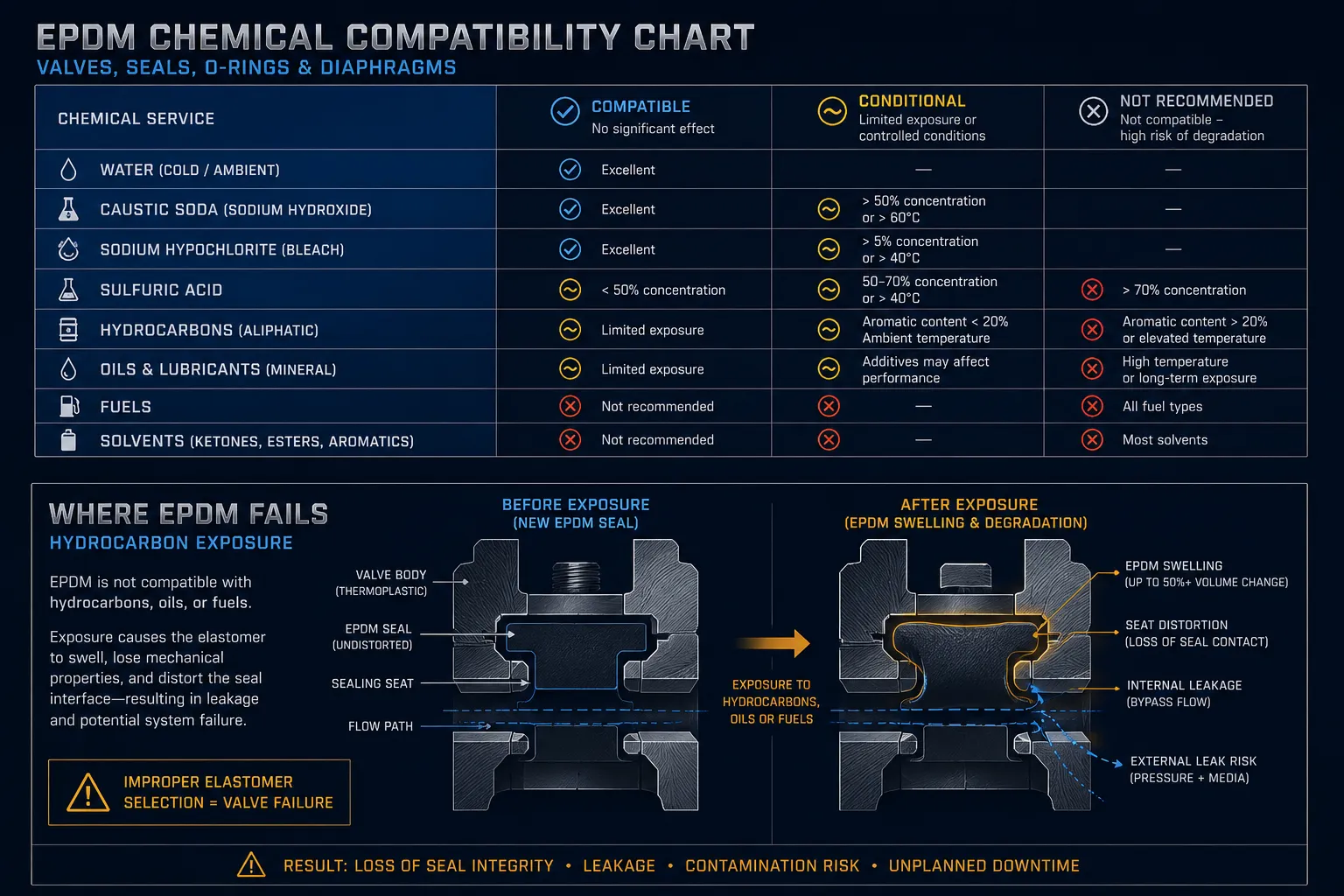
When EPDM is installed in hydrocarbon service, the failure often looks like a bad valve: swelling, seal distortion, higher operating torque, internal leakage, and eventually external leakage. But the root cause is usually not the valve brand. It is the elastomer selection.
EPDM vs FKM compatibility — which elastomer belongs in hydrocarbon service?Is EPDM Compatible With Sodium Hypochlorite?
Sometimes, but not automatically.
EPDM can be used in some sodium hypochlorite services, but the concentration, temperature, off-gassing behavior, and valve construction determine whether it is the right choice. Do not treat EPDM as approved for hypochlorite by chemical name alone.
For aggressive sodium hypochlorite valve service, the question is not only "EPDM or not?" The question is: what is the full wetted construction? A diaphragm valve may use a composite PTFE/PVDF/EPDM diaphragm, while another valve design may use different O-ring or seat materials.
Spec sodium hypochlorite carefully.
Send the concentration, temperature, pressure, and valve type before approving EPDM in sodium hypochlorite service.
Run a Hypochlorite Valve Spec CheckEPDM vs FKM vs PTFE: Which Material Should You Use?
No single elastomer covers all chemical valve services. The correct material depends on the fluid, concentration, temperature, valve type, and whether the material is acting as a seat, O-ring, seal, liner, or diaphragm layer.
| Material | Best Fit | Weak Spot | Common Valve Use |
|---|---|---|---|
| EPDM | Water, caustic, many aqueous chemicals | Oils, fuels, hydrocarbons, many solvents | O-rings, seals, diaphragms |
| FKM | Hydrocarbons, oils, fuels, many solvents | Steam, hot water, strong alkalis, some oxidizing environments depending on compound | O-rings, seats, seals |
| PTFE | Broad chemical resistance, liners, seats, aggressive chemicals | Flexibility, permeation, mechanical support | Seats, liners, diaphragm wetted layer |
| EPDM/PVDF/PTFE composite | Sodium hypochlorite/off-gassing diaphragm service | Must match valve design/manufacturer | Diaphragm valves |
Important nuance: FKM is not universally wrong for sodium hypochlorite. The right answer depends on the valve type and the specific wetted component.
FKM chemical compatibility chartPTFE diaphragm valve guide
Common EPDM Specification Mistakes That Cause Valve Failure
Choosing EPDM Because the Valve Body Is Compatible
A PVC or PVDF body can survive while the elastomer fails. Body material and elastomer material are separate decisions.
Treating Chemical Name as Enough Information
Sodium hypochlorite at 3%, 12.5%, ambient temperature, and elevated temperature are not the same service.
Ignoring Temperature
Temperature often turns a "good" material into a conditional or failed material.
Using EPDM in Hydrocarbon Service
EPDM in oil, fuel, or hydrocarbon service is one of the cleanest examples of a spec problem that gets mistaken for a valve problem.
Forgetting Off-Gassing
In sodium hypochlorite and similar media, trapped chemical in a closed valve cavity can create pressure and crystallization problems. Venting and valve design need to be reviewed before replacement.
Not Sure If EPDM Is Correct? Send the Chemistry.
If you are replacing the same valve every few months, do not start with the brand. Start with the spec.
- Chemical name
- Concentration
- Temperature
- Pressure
- Valve type
- Body material
- Seat material
- Seal/O-ring material
- Diaphragm material
- Connection type
- Whether the chemical off-gasses
Get a chemical valve spec check before the next failure.
Even though this page is EPDM-focused, sodium hypochlorite and chemical dosing applications often need a full valve construction review.
Submit My Valve SpecEPDM Chemical Compatibility FAQ
What chemicals is EPDM compatible with?
EPDM is commonly compatible with water, steam, many aqueous salts, caustic solutions, and some dilute acids. It should still be checked by concentration, temperature, pressure, and application.
Is EPDM compatible with sodium hypochlorite?
EPDM can be compatible in some sodium hypochlorite services, but it is not an automatic approval. Concentration, temperature, off-gassing, and valve design matter.
Is EPDM compatible with caustic soda?
EPDM is often a strong choice for sodium hydroxide and caustic soda service, especially in aqueous solutions, but high temperature and concentration still need to be checked.
Is EPDM compatible with sulfuric acid?
EPDM may be suitable for dilute sulfuric acid, but concentrated sulfuric acid is not a good EPDM application. Dilute sulfuric acid may screen favorably, while higher concentrations can move into limited or no-resistance territory.
Is EPDM compatible with hydrocarbons?
No, EPDM is generally not the right elastomer for hydrocarbons, fuels, petroleum oils, or many solvents.
What is better, EPDM or FKM?
Neither is better universally. EPDM is often stronger in water, steam, caustic, and aqueous service. FKM is often stronger in oils, fuels, hydrocarbons, and many solvent applications. The chemical, concentration, temperature, and valve type decide the answer.
Before You Replace the Valve Again, Check the Elastomer.
If the same chemical valve keeps failing, the valve brand may not be the problem. The elastomer may be outside its chemical, temperature, or pressure envelope.
Send LibertyCES the chemical name, concentration, temperature, pressure, and valve type. We will help you confirm whether EPDM, FKM, PTFE, or a composite diaphragm belongs in the spec.
Questions? Contact LibertyCES directly.