
Sodium Hypochlorite Valve Material Selection: Body, Seats, Seals, Diaphragms, and Venting
Sodium hypochlorite valve service is not solved by choosing a chemical-resistant body alone. The valve body may survive while the O-rings, seats, seals, diaphragm, or trapped ball cavity fail. The right spec depends on concentration, temperature, pressure, off-gassing behavior, and the exact valve type.
What Valve Materials Work With Sodium Hypochlorite?
For sodium hypochlorite valve service, the best starting point is usually a solid thermoplastic valve body with the correct elastomers, seats, diaphragm, connection style, and venting strategy.
| Valve Component | Common Sodium Hypochlorite Direction |
|---|---|
| Body | PVC or CPVC are common; PVDF or specialty thermoplastics may be used depending on concentration, temperature, and system design. |
| Ball Valve O-rings / Seals | FKM is commonly used in sodium hypochlorite ball valve configurations. |
| Ball Valve Seats | PTFE seats backed with FKM are used in manufacturer-specific hypochlorite ball valve specs. |
| Ball Cavity | A 1/8-inch upstream vent hole can be required to prevent trapped-fluid off-gassing pressure. |
| Diaphragm Valve Diaphragm | PTFE/PVDF/EPDM three-layer diaphragm construction is used for aggressive off-gassing sodium hypochlorite service. |
| Connections | Flanged or non-cemented configurations are preferred where solvent-cemented joints are a weak point. |
Why Sodium Hypochlorite Valve Specs Fail
Sodium hypochlorite valve failures often repeat because the replacement valve repeats the same original specification error. The valve may be chemically rated in a broad sense, but one part of the construction is wrong.
Acceptable Body, Wrong Elastomer
The body material may survive while the O-ring, seal, seat backing, or diaphragm backing material degrades.
Unvented Ball Cavity
Trapped sodium hypochlorite can decompose and off-gas inside the ball cavity, creating pressure and failure risk.
Seat and Backing Mismatch
The seats may be chemically resistant, but the backing cushion can still be attacked or distorted.
Wrong Diaphragm Construction
The diaphragm may have PTFE, but not the right gas-barrier layer or backing construction for off-gassing service.
Connection Weak Point
The body material can be acceptable while the connection method introduces a failure point.
Wrong Valve Type
A ball valve, diaphragm valve, butterfly valve, and check valve are not interchangeable in hypochlorite service.
Off-Gassing Inside the Valve
When a ball valve closes, fluid can become trapped inside the ball cavity. In sodium hypochlorite service, that trapped fluid can age, break down, and off-gas. That can create pressure inside the ball cavity, leading to valve failure and safety risk.
This is why sodium hypochlorite valve selection is not just a chemical resistance chart problem. It is a mechanical design problem too. A material can be compatible, but the valve can still fail if trapped chemical decomposes in a closed cavity.
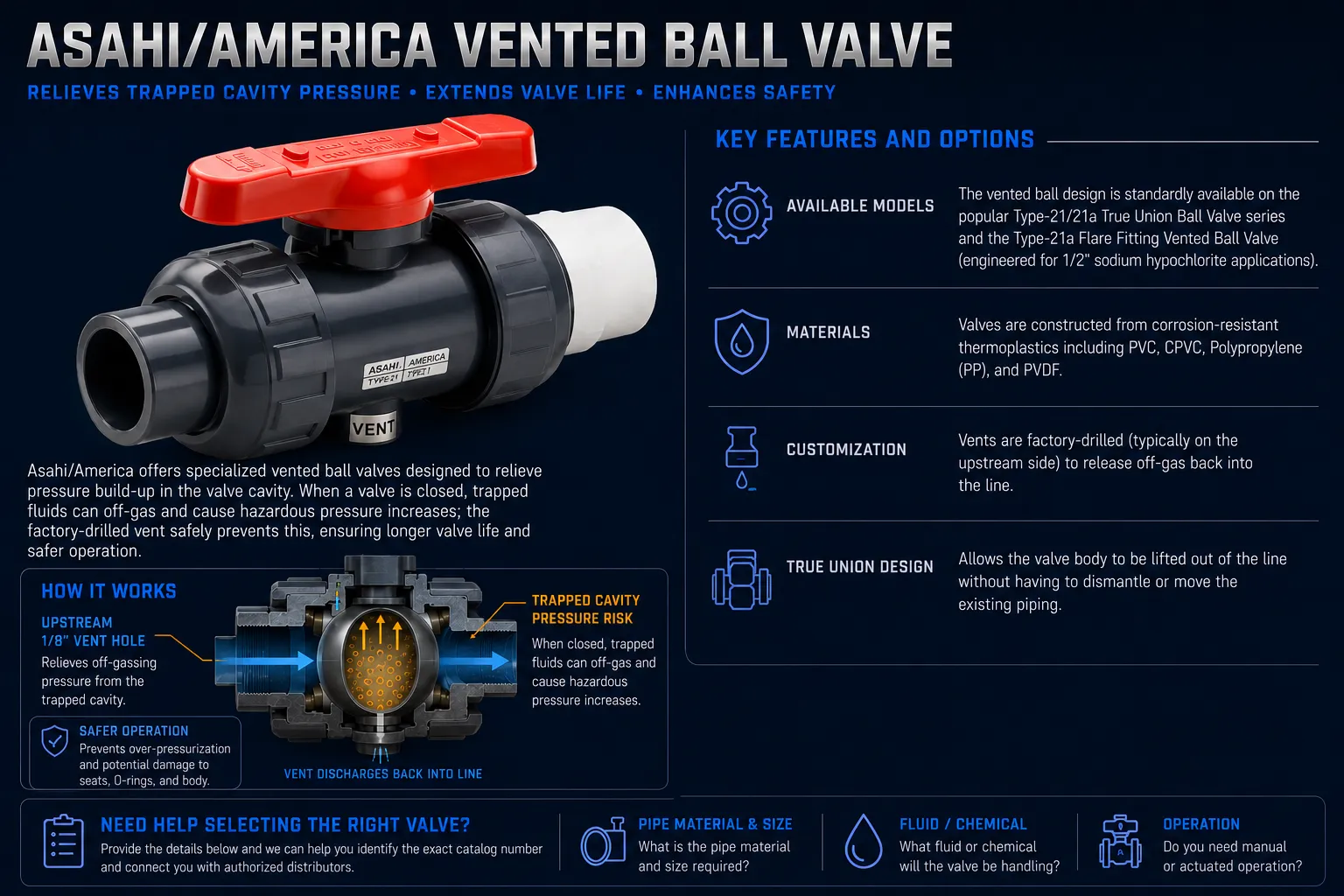
Sodium Hypochlorite Ball Valve Material Selection
Ball valves are commonly used for on/off isolation in sodium hypochlorite systems, but the material spec must include more than the body.
| Component | Recommended Page Language |
|---|---|
| Body | PVC or CPVC are common sodium hypochlorite body materials in manufacturer-specific configurations. |
| O-rings / Seals | FKM is commonly specified in sodium hypochlorite ball valve configurations. |
| Seats | PTFE seats backed with FKM are used in sodium hypochlorite ball valve configurations. |
| Venting | A 1/8-inch vent hole can be used to relieve trapped cavity issues and should be installed upstream when required. |
| Connections | Flanged configurations can remove solvent-cemented joint risk. |
Sodium Hypochlorite Diaphragm Valve Material Selection
Diaphragm valves are often a better discussion when the sodium hypochlorite application involves throttling, dosing, chemical feed control, or aggressive off-gassing concerns.
For diaphragm valves, the critical question is not simply “EPDM or PTFE?” The critical question is: what is the diaphragm construction?
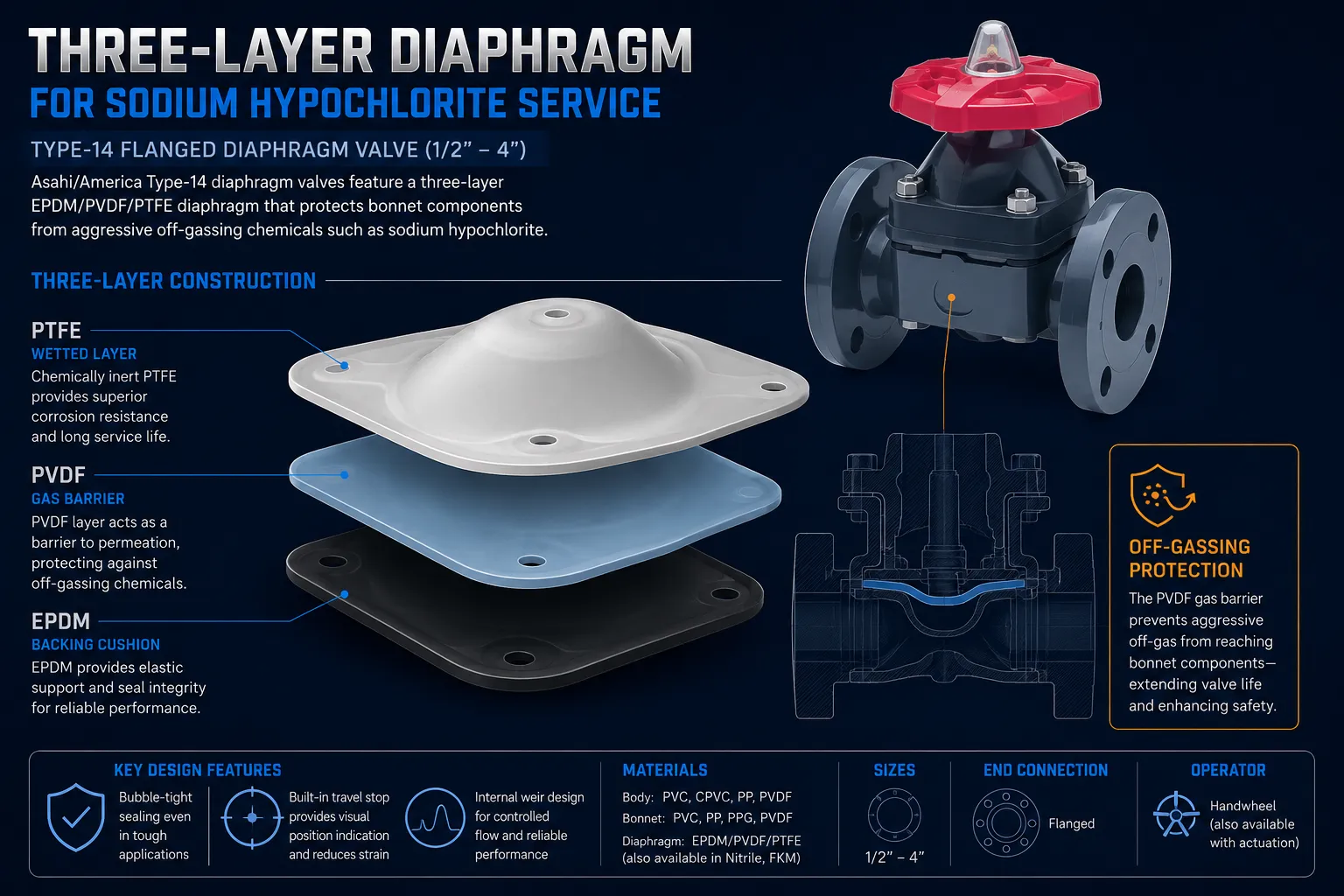
| Component | Sodium Hypochlorite Spec Direction |
|---|---|
| Body / Bonnet | Solid thermoplastic PVC or CPVC construction |
| Diaphragm Wetted Layer | PTFE |
| Gas Barrier | PVDF |
| Backing Cushion | EPDM |
| Valve Type | Weir-type diaphragm valve |
| Connections | Flanged or non-cemented options depending on system design |
EPDM, FKM, or PTFE for Sodium Hypochlorite?
There is no single one-word material answer for sodium hypochlorite. The right material depends on which valve component you are selecting.
| Material | Correct Sodium Hypochlorite Framing |
|---|---|
| EPDM | Can be used in certain constructions, especially as a diaphragm backing layer, but should not be approved by chemical name alone. |
| FKM | Used in some ball valve O-ring/seal configurations, but not automatically the right material for every hypochlorite component. |
| PTFE | Often used as a seat or wetted diaphragm layer, but may need FKM backing or PVDF/EPDM layered construction. |
| PVDF | Can act as a gas-barrier layer in composite diaphragm construction. |
FKM chemical compatibility chart
PTFE diaphragms for chemical processing
PVC, CPVC, or PVDF for Sodium Hypochlorite Valves?
PVC and CPVC are common sodium hypochlorite valve body materials in manufacturer-approved configurations. PVDF or specialty thermoplastic construction may be evaluated where concentration, temperature, pressure, purity, or system design requires it.
PVC and CPVC are common sodium hypochlorite valve body materials when used in a manufacturer-approved configuration. The final choice still depends on concentration, temperature, pressure, installation method, and connection style.
Do Not Specify Body Only
A compatible body with the wrong seats, seals, O-rings, diaphragm, venting, or connection style can still fail early.
Connection Style Matters
For sodium hypochlorite systems, do not only ask what the valve body is made from. Ask how the valve is connected. A compatible body with a vulnerable connection detail can still become the failure point.
What Happens When the Wrong Sodium Hypochlorite Valve Is Installed?
A sodium hypochlorite valve can fail even when the body material looks correct on a compatibility chart. If the valve is unvented, the elastomers are wrong, the seats are unsupported, the diaphragm lacks a gas barrier, or the connection method is vulnerable, the system can still fail early.
- Wrong valve configuration enters service
- Sodium hypochlorite begins decomposing or off-gassing
- Trapped chemical pressurizes the ball cavity
- Elastomers are attacked or backing cushions degrade
- Seats distort or lose sealing force
- Valve torque increases
- Internal leakage begins
- External leakage or safety risk follows
- Maintenance replaces the same valve
- The failure repeats
Sodium Hypochlorite Valve Spec Matrix
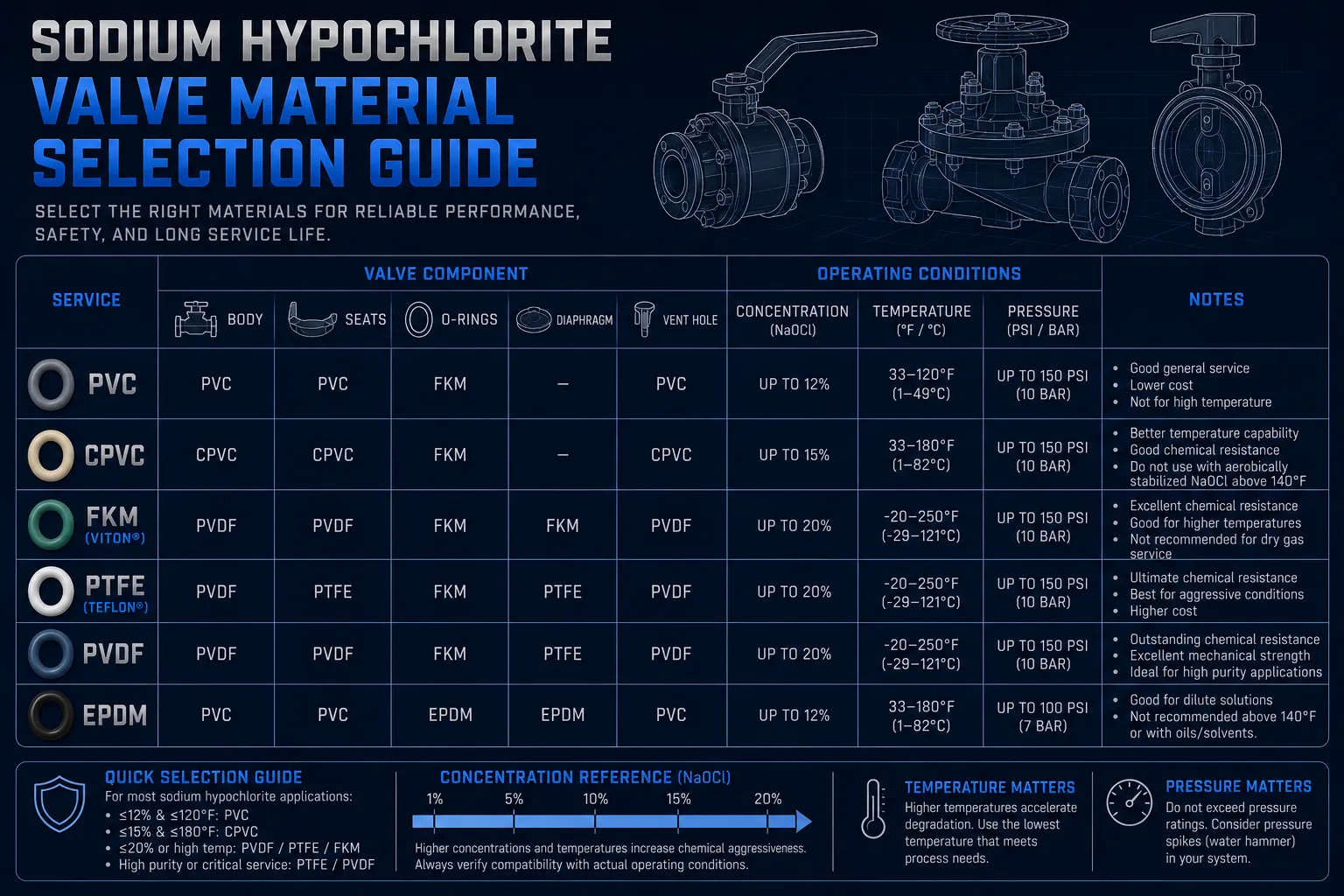
| Application | Valve Type | Body | Seats / Diaphragm | Seals / O-Rings | Critical Detail |
|---|---|---|---|---|---|
| On/off isolation | Ball valve | PVC or CPVC | PTFE seats backed with FKM | FKM | 1/8-inch upstream vent hole |
| Chemical feed control | Diaphragm valve | PVC or CPVC | PTFE/PVDF/EPDM three-layer diaphragm | Matched to diaphragm/system | PVDF gas barrier |
| Higher off-gassing concern | Diaphragm valve | Manufacturer-approved thermoplastic | PTFE wetted face with PVDF gas barrier | Manufacturer-approved | Avoid generic PTFE-only assumptions |
| Systems with cemented-joint failures | Flanged valve | PVC or CPVC | Application-specific | Application-specific | Eliminate solvent-cemented joint exposure |
| Unknown concentration/temp | Do not guess | TBD | TBD | TBD | Submit full chemical data before ordering |
Sodium Hypochlorite Valve Specification Checklist
Before selecting a sodium hypochlorite valve, confirm these details.
Common Sodium Hypochlorite Valve Material Mistakes
Choosing by Body Material Only
The valve body can be correct while the seals, seats, O-rings, or diaphragm are wrong.
Ignoring Concentration
A 3% hypochlorite solution and a 12.5% hypochlorite solution are not the same application.
Ignoring Temperature
Compatibility gets tighter as temperature rises. Material screening must consider both concentration and temperature.
Installing an Unvented Ball Valve
In sodium hypochlorite service, trapped ball-cavity fluid can off-gas and create pressure.
Treating PTFE as a Magic Fix
PTFE is often useful, but diaphragm construction still matters. PTFE may need PVDF and EPDM support layers in aggressive off-gassing service.
Forgetting the Connection Method
Sodium hypochlorite can expose weaknesses in solvent-cemented joining. Flanged or non-cemented approaches may be needed depending on the system.
Get a Sodium Hypochlorite Valve Spec Check
If your sodium hypochlorite valves keep failing, stop reordering the same configuration until the spec has been reviewed.
Send LibertyCES
- Chemical concentration
- Operating temperature
- Pressure
- Valve size
- Valve type
- Body material
- Seat material
- O-ring/seal material
- Diaphragm construction
- Connection type
- Failure history
- Photos of the valve tag or failed component
We Help You Determine
Whether the application needs a vented ball valve, diaphragm valve, PTFE/PVDF/EPDM diaphragm, FKM seals, PTFE-backed seats, flanged construction, or a different thermoplastic configuration.
Before you replace the hypochlorite valve again, check the spec.
Send the chemical concentration, temperature, pressure, valve size, valve type, body material, seat material, seal material, diaphragm material, connection style, and failure history.
Run My Hypochlorite Valve Spec CheckSodium Hypochlorite Valve Material FAQ
What valve material is best for sodium hypochlorite?
Is PVC compatible with sodium hypochlorite?
Is FKM compatible with sodium hypochlorite?
Is EPDM compatible with sodium hypochlorite?
Why do sodium hypochlorite ball valves need a vent hole?
What diaphragm is used for sodium hypochlorite service?
Can I use a normal ball valve for sodium hypochlorite?
Before You Replace the Hypochlorite Valve Again, Check the Spec
If the same sodium hypochlorite valve keeps failing, do not start by changing brands. Start by checking the material construction.
Send LibertyCES the chemical concentration, temperature, pressure, valve size, valve type, body material, seat material, seal material, diaphragm material, connection style, and failure history.
We will help you determine whether the application needs a vented ball valve, diaphragm valve, PTFE/PVDF/EPDM diaphragm, FKM seals, PTFE-backed seats, flanged construction, or a different thermoplastic valve strategy.