
Buna-N vs EPDM vs FKM vs PTFE: Which Valve Seal Material Should You Use?
Buna-N, EPDM, FKM, and PTFE are all common valve sealing materials, but they solve different chemical problems. Buna-N is commonly selected for oil and fuel service. EPDM is commonly selected for water, steam, caustic, and many aqueous chemicals. FKM is used for higher-temperature oil, fuel, solvent, and chemical service. PTFE is used where broad chemical resistance, low contamination risk, or aggressive media protection matters.
Buna-N vs EPDM vs FKM vs PTFE
The wrong seal material can make a good valve look cheap. Buna-N, EPDM, FKM, and PTFE each survive different chemical families. The mistake is treating them like a price ladder. The spec wins when the material matches the chemistry.
| Material | Best Short Answer |
|---|---|
| Buna-N / NBR / Nitrile | Best low-cost choice for many oils, fuels, greases, and hydraulic fluids. |
| EPDM | Best common choice for water, steam, caustic, ozone, weathering, and many aqueous services. |
| FKM / Fluorocarbon | Best upgrade for higher-temperature oil, fuel, solvent, and demanding chemical service. |
| PTFE | Best chemical barrier for aggressive chemicals, high purity, seats, liners, and diaphragm faces. |
Do not choose the material by price or habit. Choose it by chemical family first.
Buna-N vs EPDM vs FKM vs PTFE Comparison Chart
Buna-N, EPDM, and FKM are elastomers. PTFE is not a rubber elastomer in the same way. PTFE is usually used as a chemical barrier, liner, seat, or diaphragm face, often with another material providing flexibility or mechanical support.

| Material | Also Called | Strong In | Weak In | Common Valve Parts | Best Use Case |
|---|---|---|---|---|---|
| Buna-N | NBR, Nitrile | Petroleum oils, fuels, greases, hydraulic fluids | Ozone, weathering, steam, many ketones, esters, chlorinated solvents | O-rings, seals, gaskets | Cost-effective oil and fuel sealing |
| EPDM | EPR, ethylene propylene | Water, steam, caustic, ozone, weathering, many aqueous chemicals | Oils, fuels, hydrocarbons, many solvents | O-rings, seals, diaphragms | Water and wastewater chemical service |
| FKM | Fluorocarbon, Viton-type material | Oils, fuels, high heat, many solvents, many aggressive chemicals | Steam, hot water, strong bases, amines, ketones | O-rings, seals, seats | Higher-temperature chemical and hydrocarbon service |
| PTFE | Teflon-type fluoropolymer | Broad chemical resistance, aggressive acids, oxidizers, high-purity service | Creep, cold flow, permeation in certain media, low elasticity | Seats, liners, diaphragm faces, packing | Chemical barrier and purity-critical service |
What Is Buna-N Best For?
Buna-N, also called NBR or nitrile, is commonly used where the valve seal needs resistance to petroleum oils, fuels, greases, and hydraulic fluids.
Best Applications
- Petroleum oil
- Diesel fuel
- Fuel oil
- Grease
- Hydraulic fluid
- Some aliphatic and aromatic hydrocarbons
- General industrial sealing where cost matters
Weaknesses
Buna-N is not the material you want for many oxidizing chemicals, ozone-heavy outdoor exposure, steam, hot water, ketones, esters, or chlorinated hydrocarbons.
Buna-N is often a good economical seal material, but it should not be carried into water-treatment oxidizer service just because it worked in an oil or pump application.
What Is EPDM Best For?
EPDM is commonly selected for water, steam, caustic, weathering, ozone, and many aqueous chemical services.
Best Applications
- Potable water
- Wastewater
- Hot water
- Steam, within limits
- Caustic soda
- Sodium hydroxide
- Many aqueous salts
- Many water-treatment chemicals
- Outdoor and weathered applications
Weaknesses
EPDM is generally not recommended for most oils and fuels. That is the big mistake.
If the service is hydrocarbon, fuel, oil, or petroleum-based, do not default to EPDM. Use the chart, then confirm Buna-N, FKM, or another material depending on the full application.
EPDM is one of the most common water and wastewater valve elastomers because it fits many aqueous services, but that does not make it universal.
EPDM chemical compatibility chartWhat Is FKM Best For?
FKM is a higher-performance fluorocarbon elastomer used when the service needs stronger chemical resistance, higher temperature capability, oil/fuel resistance, ozone resistance, or aging resistance than Buna-N can provide.
Best Applications
- Hydrocarbons
- Fuels
- Oils
- Gasoline and gasoline/alcohol blends
- Many solvents
- High-temperature chemical service
- Weathering and ozone exposure
Weaknesses
FKM is not automatically correct for every aggressive chemical. Strong bases, amines, ketones, steam, and hot water can be problem areas depending on grade and conditions.
Some people see “Viton” or “FKM” and assume it is always the premium answer. It is not. In the wrong chemical family, the premium material still fails.
FKM often belongs where Buna-N is too limited, but it is not a replacement for EPDM in every water, steam, caustic, or oxidizing application.
FKM chemical compatibility chartWhat Is PTFE Best For?
PTFE is used when the valve needs a broad chemical-resistant wetted surface, low contamination risk, or a barrier against aggressive media.
Best Applications
- Aggressive acids
- Oxidizers
- High-purity chemicals
- Chemical-processing diaphragm faces
- Ball valve seats
- Valve liners
- Applications where elastomer swelling is unacceptable
Weaknesses
PTFE is not a flexible rubber seal like EPDM, Buna-N, or FKM. It can have mechanical issues such as creep, cold flow, flex fatigue, or permeation depending on media and design.
PTFE often works best as a seat, liner, or diaphragm face. In diaphragm valves, PTFE may need an elastomer backing or a composite construction to provide flexibility and sealing force.
Which Material Should You Choose by Application?
The correct material is not the one with the best reputation. It is the one that survives that specific chemical family at that specific concentration and temperature.
| Application | Best Starting Material | Why |
|---|---|---|
| Potable water | EPDM | Strong fit for water and many aqueous services |
| Wastewater | EPDM | Common elastomer for water/wastewater valves |
| Hot water / steam | EPDM | Better starting point than Buna-N or FKM in many steam/water services |
| Petroleum oil | Buna-N or FKM | Buna-N is economical; FKM upgrades temperature and chemical margin |
| Diesel / fuel oil | Buna-N or FKM | Hydrocarbon service generally points away from EPDM |
| Gasoline | FKM or Buna-N | FKM often preferred for higher performance |
| Caustic soda | EPDM | EPDM is often strong in aqueous caustic service |
| Sodium hypochlorite | Application-specific | Check concentration, temperature, off-gassing, and valve design |
| Aggressive acid | PTFE or FKM, depending on acid | Must verify acid type, concentration, and temperature |
| Solvents | FKM or PTFE, depending on solvent | Solvent family decides the answer |
| High-purity chemicals | PTFE / PFA-wetted designs | Low contamination and broad chemical resistance |
| Outdoor ozone/weathering | EPDM or FKM | Buna-N is usually weaker outdoors |
Buna-N, EPDM, FKM, or PTFE for Sodium Hypochlorite?
Do not choose sodium hypochlorite valve materials from a generic elastomer hierarchy. For sodium hypochlorite, the question is not simply “EPDM or FKM?” The better question is: what is the full wetted construction of the valve?
Hypochlorite Variables
- Concentration
- Temperature
- Valve body material
- O-ring material
- Seat material
- Diaphragm material
- Off-gassing behavior
- Ball valve vs diaphragm valve construction
Why This Service Is Different
Sodium hypochlorite can involve oxidizer exposure, off-gassing, trapped cavity pressure, and crystallization concerns. A material that looks fine in a general compatibility chart can fail when the valve design ignores venting, seat backing, or diaphragm construction.
Do not guess on sodium hypochlorite.
Send us the chemical concentration, temperature, pressure, and valve type. LibertyCES will help screen the body material, O-ring, seat, diaphragm, and off-gassing risk before you replace the same valve again.
Run a Hypochlorite Valve Spec CheckWhat Happens When the Wrong Seal Material Is Specified?
Most recurring valve failures are not mysterious. The valve is often doing exactly what the material spec allowed it to do. EPDM in hydrocarbon service swells. Buna-N in oxidizing or ozone-heavy service breaks down. FKM in the wrong alkaline or amine service fails. PTFE in the wrong construction creeps, permeates, or loses sealing performance.
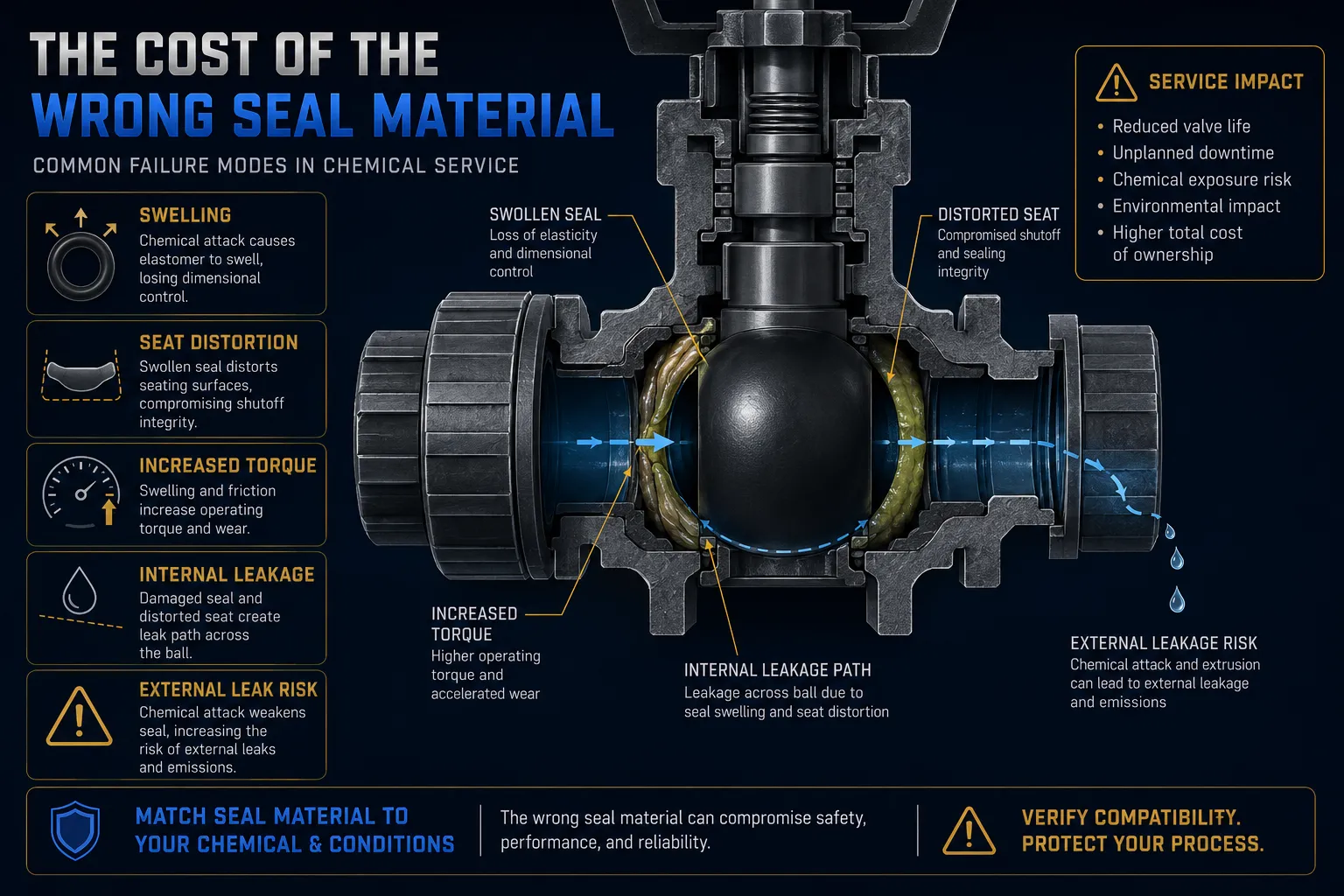
- Wrong material enters service
- Chemical attack begins
- Seal swells, hardens, cracks, or creeps
- Torque increases
- Bubble-tight shutoff is lost
- Internal leakage begins
- External leakage or body-joint failure follows
- The valve brand gets blamed
- The same wrong spec gets reordered
Fast Material Selection Decision Tree
Use this as a starting point only. The final selection still needs chemical concentration, temperature, pressure, valve type, body material, and part function.
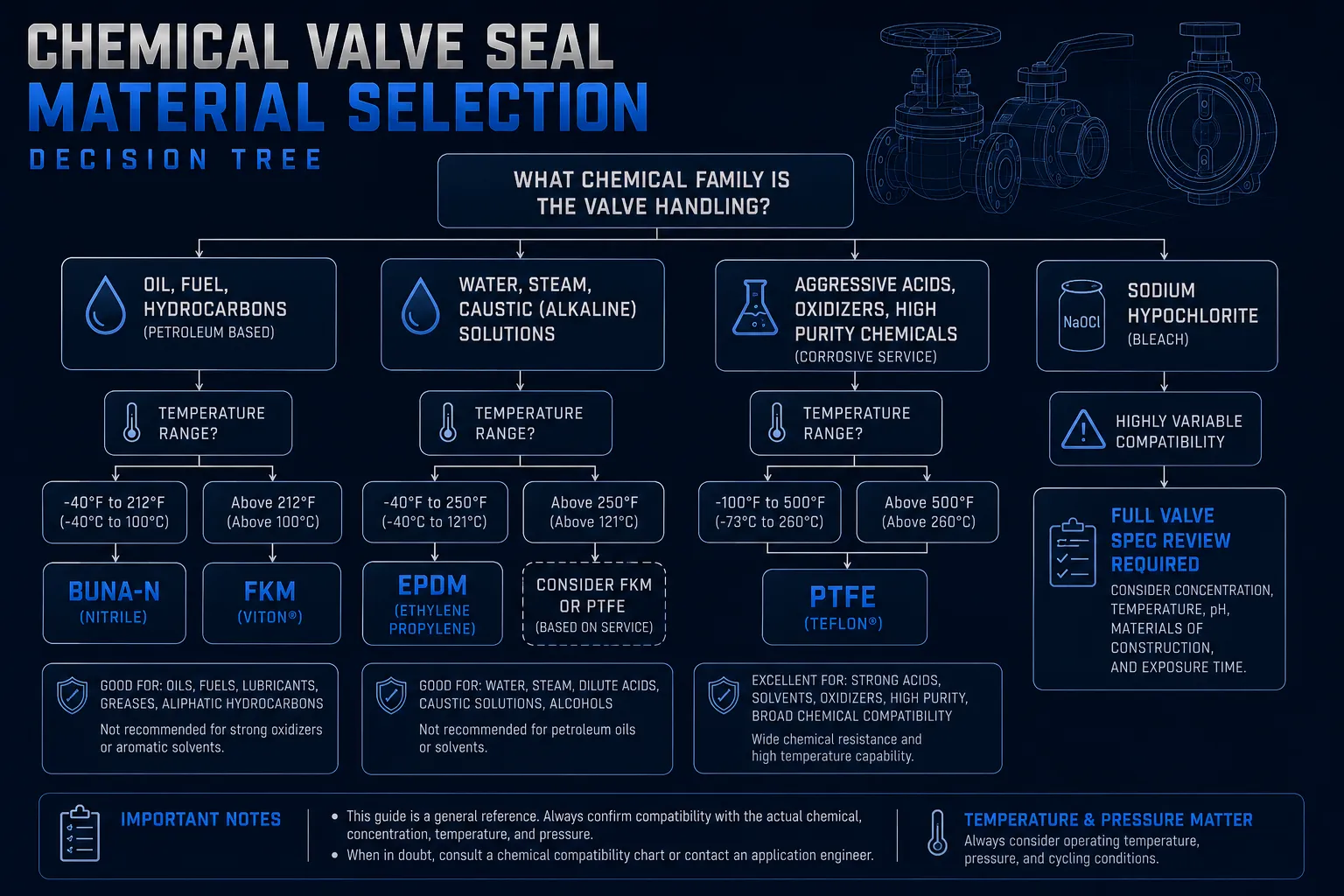
Is the media petroleum oil, fuel, grease, or hydraulic fluid?
Start with Buna-N or FKM.
Is the media water, steam, caustic, or an aqueous water-treatment chemical?
Start with EPDM.
Is the media hot oil, fuel, solvent, or a higher-temperature chemical service?
Start with FKM.
Is the media aggressive acid, oxidizer, high-purity chemical, or broad chemical unknown?
Evaluate PTFE, PFA, or a PTFE-faced construction.
Is the media sodium hypochlorite?
Stop and verify the full valve construction.
Common Mistakes When Comparing Buna-N, EPDM, FKM, and PTFE
Treating FKM as Automatically Better
FKM is more chemically and thermally capable in many services, but it is not automatically better in steam, caustic, amines, ketones, or every oxidizer.
Using EPDM in Oil or Hydrocarbon Service
EPDM is not an oil/fuel elastomer. This is one of the easiest wrong specs to avoid.
Using Buna-N Outside Its Comfort Zone
Buna-N is strong in oil and fuel service, but it is not the right choice for ozone, weathering, steam, or many aggressive chemical environments.
Treating PTFE Like a Rubber Seal
PTFE is a chemical barrier and seat/liner material. It does not behave like Buna-N, EPDM, or FKM.
Ignoring Temperature
A material that survives at ambient temperature may fail at elevated temperature.
Forgetting Which Part Uses the Material
A valve may have a PVC body, PTFE seat, FKM O-rings, and EPDM diaphragm. Saying “the valve is PTFE” is not enough.
Buna-N vs EPDM vs FKM vs PTFE FAQ
Is Buna-N the same as NBR?
Is Buna-N better than EPDM?
Is EPDM better than FKM?
Is FKM the same as Viton?
Is PTFE better than FKM?
Which seal material is best for sodium hypochlorite?
Which seal material is best for caustic soda?
Which seal material is best for oil and fuel?
Stop Comparing Materials in Isolation. Send the Chemistry.
Buna-N, EPDM, FKM, and PTFE can all be correct. They can also all be wrong.
The right valve seal material depends on the chemical, concentration, temperature, pressure, valve type, body material, and whether the material is being used as a seat, seal, O-ring, diaphragm, or liner.
Send LibertyCES the application details. We will help confirm whether Buna-N, EPDM, FKM, PTFE, or a composite diaphragm belongs in the spec.