
PTFE Diaphragms for Chemical Processing: When PTFE Is Right, and When Composite Construction Matters
PTFE diaphragms are used in aggressive chemical valve service because the PTFE face provides broad chemical resistance. But the final valve spec depends on more than the wetted surface. Backing material, body material, temperature, pressure, permeation, off-gassing, and diaphragm construction all determine whether the valve survives.
What Is a PTFE Diaphragm Used For?
A PTFE diaphragm is used when the wetted valve surface needs high chemical resistance against aggressive acids, oxidizers, solvents, or high-purity chemicals. In diaphragm valves, PTFE usually acts as the chemical barrier, while another material behind it provides flexibility, compression, and mechanical support.
This matters because PTFE is chemically resistant, but it is not automatically the complete answer. In aggressive chemical processing, the right diaphragm may be PTFE-faced, PTFE-lined, or multi-layered with support materials such as EPDM, FKM, or PVDF.
What Is a PTFE Diaphragm?
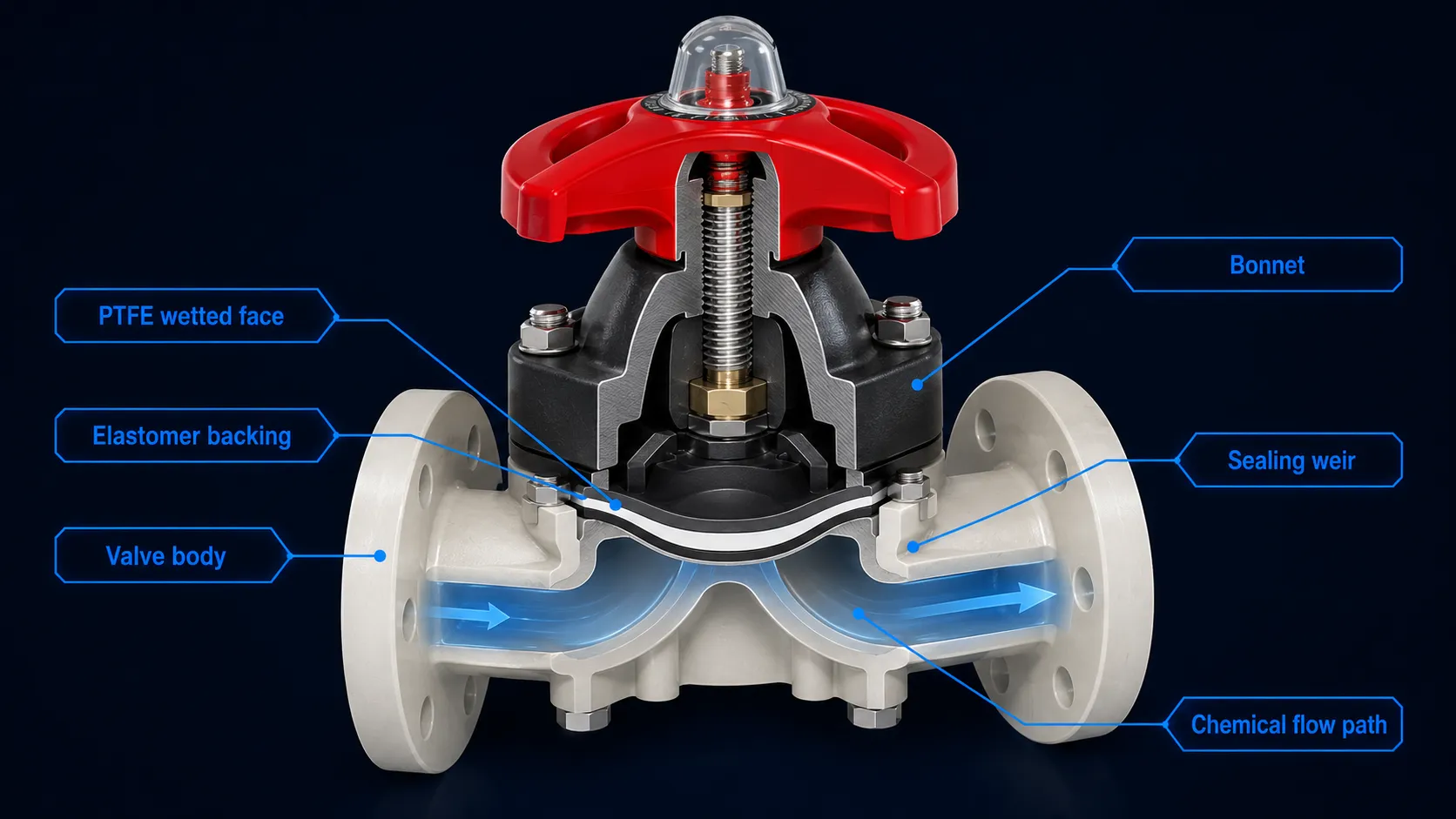
A PTFE diaphragm is a valve diaphragm with a PTFE wetted face. The PTFE layer contacts the chemical media, while the backing material provides the mechanical elasticity needed for sealing and cycling.
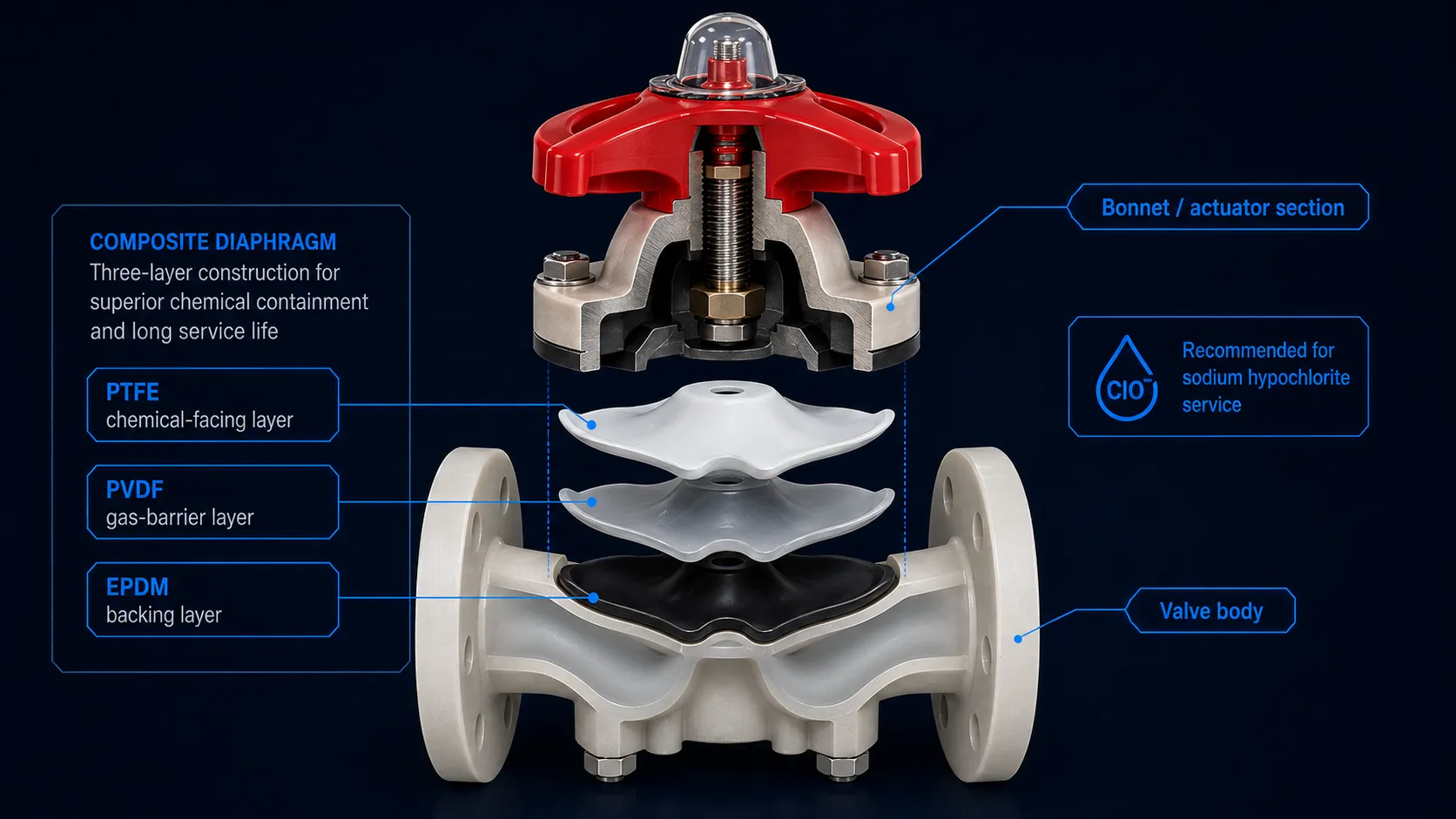
In many chemical processing valves, the diaphragm is not just one material. It may be a bonded or layered construction designed to combine chemical resistance, elastomer flexibility, gas-barrier performance, mechanical support, and bonnet protection from aggressive vapors or off-gassing chemicals.
PTFE Face
The PTFE face is the chemical-facing barrier. It is selected when the chemical would attack, swell, soften, or degrade a standard elastomer diaphragm.
Backing Layer
The backing layer provides mechanical support. It helps the diaphragm flex, compress, recover, and seal during valve cycling.
PVDF Barrier Layer
In certain composite diaphragms, a PVDF layer can be used as a gas-barrier layer for aggressive off-gassing service such as sodium hypochlorite or wet chlorine exposure.
Valve Body Context
The diaphragm cannot solve the whole application by itself. Body material, seat geometry, actuation, pressure, and temperature still define the final valve spec.
Why PTFE Is Used in Chemical Processing Valves
1. Broad Chemical Resistance
PTFE is used because it resists a wide range of aggressive chemicals. That makes it valuable in chemical processing, water treatment, bleach systems, acid service, high-purity systems, and applications where standard elastomers may swell, crack, soften, or degrade.
2. Low Contamination Risk
PTFE is often selected where the media cannot tolerate contamination from elastomer extraction, leaching, or reaction. This is why PTFE and PFA-wetted valve designs are common in high-purity and corrosive chemical systems.
3. Aggressive Acid and Oxidizer Fit
PTFE diaphragms can be a strong fit for aggressive chemical media, but the exact construction still matters. PTFE-backed and PTFE-composite diaphragm grades are not interchangeable.
4. Better Barrier Than Many Elastomers
EPDM and FKM are elastomers. PTFE is a fluoropolymer barrier. PTFE can resist chemicals that would attack standard rubber diaphragms, but it may still need a backing layer to flex and seal properly.
Where PTFE Diaphragms Can Still Fail
PTFE is a strong chemical barrier, but it is not magic. In valve service, failure often comes from the interaction between chemical exposure, mechanical cycling, compression, temperature, body material, and off-gassing.
Permeation
PTFE is highly chemically resistant, but aggressive media and gases can still create permeation concerns. In off-gassing service, that can expose bonnet internals or non-wetted components to attack.
Creep and Compression Set
PTFE can deform under sustained load. In diaphragm valves, that matters because the diaphragm has to seal repeatedly against the weir or seat while maintaining reliable shutoff.
Poor Fit Without Proper Backing
A pure PTFE surface may resist the chemical but lack the resilience required for the valve’s mechanical duty. That is why PTFE diaphragms often use elastomer backing or multi-layer construction.
Wrong Body Material
A PTFE diaphragm does not fix an incompatible valve body. If PVC, CPVC, PP, PVDF, PTFE-lined metal, or PFA-lined construction is wrong for the chemical, the diaphragm choice will not save the valve.
Wrong Valve Type
A PTFE diaphragm valve and a PTFE-seated ball valve solve different problems. Do not specify “PTFE” without defining the valve type, wetted parts, and service conditions.
Unverified Operating Conditions
Temperature, concentration, pressure, cycling frequency, solids, vapor formation, and actuation force all change diaphragm life. A chart rating alone is not a final approval.
PTFE vs EPDM vs FKM Diaphragms
No single diaphragm material covers every chemical valve service. EPDM and FKM are elastomer choices. PTFE is usually a chemical barrier choice. Composite diaphragms combine chemical resistance with mechanical support.
| Diaphragm Material | Best Fit | Weakness | Common Use |
|---|---|---|---|
| EPDM | Water, caustic, many aqueous chemicals | Hydrocarbons, oils, fuels, many solvents | Water treatment, caustic systems, selected chemical dosing |
| FKM | Oils, hydrocarbons, fuels, many solvents | Steam, hot water, strong alkalis, some oxidizers depending on compound | Solvent and hydrocarbon chemical service |
| PTFE | Aggressive acids, oxidizers, high-purity chemicals, broad chemical resistance | Creep, flex fatigue, permeation in some gases or media | Wetted diaphragm face, liners, seats |
| PTFE/PVDF/EPDM Composite | Sodium hypochlorite, wet chlorine, aggressive off-gassing service | Must match manufacturer design and valve type | Specialty diaphragm valve service |
| PTFE/PVDF/FKM Composite | Aggressive service where FKM backing is preferred | Must match exact media and temperature | Specialty industrial chemical service |
EPDM vs FKM compatibility
FKM chemical compatibility chart
PTFE Diaphragms in Sodium Hypochlorite Service
PTFE can be part of the correct sodium hypochlorite valve spec, but the best design may not be a simple PTFE diaphragm. In aggressive sodium hypochlorite service, off-gassing and permeation matter.
For sodium hypochlorite, wet chlorine, and off-gassing chemical service, the issue is not only liquid chemical resistance. Vapors and gases can migrate through or around materials and attack bonnet internals, fasteners, or non-wetted valve components.
Why the PVDF Layer Matters
In sodium hypochlorite, wet chlorine, and aggressive off-gassing service, a layered diaphragm can outperform a simple material choice because the gas-barrier layer helps protect components behind the wetted face.
Why Full Construction Matters
Hypochlorite service should be specified by full valve construction: body material, diaphragm design, seat, O-ring, pressure, temperature, concentration, off-gassing, venting, and actuation.
Spec sodium hypochlorite by full valve construction, not by one material name.
Send the chemical concentration, temperature, pressure, valve type, body material, seat, seal, O-ring, diaphragm, and off-gassing details. LibertyCES will help screen the correct valve direction before you repeat the same failure.
Run a Hypochlorite Valve Spec CheckWhere PTFE Diaphragms Are Commonly Used
Bleach and Sodium Hypochlorite Systems
Use PTFE-faced or composite diaphragms when the system involves oxidizing chemistry, off-gassing, and bonnet-protection concerns.
Acid Feed Systems
PTFE diaphragms are often evaluated for aggressive acid service, especially where standard elastomers are not suitable.
High-Purity Chemical Systems
PTFE and PFA wetted parts are often selected for high-purity chemical systems because they reduce contamination risk and provide high chemical resistance.
Chemical Dosing Systems
PTFE diaphragms can be used in dosing systems where chemical resistance is more important than abrasion resistance.
Semiconductor and Specialty Chemical Service
High-purity plastic diaphragm valves with PTFE or PFA wetted parts are often used where metallic contamination, leaching, or corrosion risk must be minimized.
Water and Wastewater Treatment
PTFE-faced and composite diaphragm constructions may be evaluated for oxidizers, acids, chemical feed systems, and high-consequence process points.
How to Specify a PTFE Diaphragm Valve
Before choosing PTFE, define the whole application. The diaphragm is only one part of the valve system.
- Chemical name: Do not use trade names alone. Identify the actual chemical.
- Concentration: A 5% solution and a 50% solution are not the same service.
- Temperature: Temperature changes chemical attack, permeation, flexibility, and pressure limits.
- Pressure: Confirm valve pressure rating at the actual operating temperature.
- Valve body material: PVC, CPVC, PP, PVDF, PTFE-lined metal, and PFA-lined designs are not interchangeable.
- Diaphragm construction: Specify EPDM, FKM, PTFE-faced, PTFE/EPDM, PTFE/FKM, PTFE/PVDF/EPDM, or PTFE/PVDF/FKM.
- Off-gassing: Critical for sodium hypochlorite, chlorine-related service, and other aggressive oxidizing media.
- Cycling frequency: High-cycle valves need diaphragms that can flex repeatedly without premature fatigue.
- Slurry or solids: PTFE may provide chemical resistance, but abrasion and solids handling may require another strategy.
- Actuation: Manual, pneumatic, and electric actuation affect closing force, repeatability, and diaphragm life.
Common PTFE Diaphragm Specification Mistakes
Specifying PTFE as a Catch-All
PTFE has broad resistance, but compatibility charts are not final approvals. Operating conditions still matter.
Ignoring Permeation
PTFE can still allow permeation in certain aggressive media, especially where gases or vapors are part of the service conditions.
Forgetting the Backing Material
The PTFE face handles chemical exposure. The backing material helps the diaphragm flex, compress, recover, and seal.
Using PTFE When the Body Is Wrong
A PTFE diaphragm does not make a PVC, CPVC, PP, or PVDF body automatically compatible.
Ignoring Hypochlorite Off-Gassing
Hypochlorite systems need special attention because off-gassing can attack bonnet internals or create pressure and crystallization issues.
Confusing PTFE Seats with PTFE Diaphragms
A PTFE seat in a ball valve is not the same as a PTFE diaphragm in a diaphragm valve. The failure modes are different.
PTFE Diaphragm FAQ
What is a PTFE diaphragm valve used for?
Is PTFE better than EPDM for chemical processing?
Why do PTFE diaphragms need backing material?
What is a PTFE/PVDF/EPDM diaphragm?
Can PTFE fail in chemical service?
Is PTFE good for sodium hypochlorite?
Send the Chemistry. We’ll Help Screen the Valve Spec.
PTFE, EPDM, FKM, and composite diaphragms are not interchangeable. The right answer depends on the full service envelope.
Send LibertyCES the chemical, concentration, temperature, pressure, valve type, body material, seat, seal, O-ring, diaphragm, off-gassing details, cycling frequency, and actuation requirements.
