Flowline
Level transmitters, switches, and flow switches — plus a 285-chemical materials compatibility reference identifying where 316 stainless steel corrodes.
What LibertyCES specifies from Flowline

LD33 is explicitly named for corrosive chemical service with PTFE/FEP wetted material; LD32 for wastewater lift stations.

LU10 is the only intrinsically safe switch in the line and named for chemical/solvent/light oil service; LZ12 is named specifically for wastewater.
Flowline — Real Catalog Spec Data
| Product Line | Model | Category | Material | Size / Capacity | Temp Rating |
|---|---|---|---|---|---|
| Level Transmitters | LR80/81/83/85 (80 GHz Radar) | Instrument | PVDF/PFA antenna | 32.8-393.7 ft range | 140F-248F |
| Level Transmitters | UG/US Series (Reflective Ultrasonic) | Instrument | PVDF transducer | 9.8-39.3 ft range | up to 176F |
| Level Transmitters | DX10/DL Series (Ultrasonic) | Instrument | PVDF | 1.25-5.5 m range | up to 140F |
| Level Transmitters | LD30-LD37 (Pressure/Submersible) | Instrument | 316 stainless, PVC, PUR, PTFE, or FEP | up to 34.65 ft range | - |
| Level Transmitters | LR15/16/20/21 (26 GHz Radar) | Instrument | 316L, optional PTFE | 65.6-98.4 ft range | up to 302F |
| Level Transmitters | LR36/41 (26 GHz Radar, Solids) | Instrument | 316L, optional PTFE dust shield | 49.2-229.7 ft range | 392F-752F |
| Level Transmitters | LG10 (Guided Wave) | Instrument | 316L probe | 9.8 ft range | up to 302F |
| Tank Level Monitors | HB01 | Instrument | IP67 enclosure | 1-4 BLE sensor inputs | - |
| Level Switches | AXXX/AX23/AX1X/AX13 (Corrosion Resistant) | Instrument | PP or PP/PVDF | top/wall mount | -40F to 176F |
| Level Switches | LU10 (Ultrasonic Switch) | Instrument | PP/PFA | universal mount | -40F to 176F |
| Level Switches | LZ12 (Vibration Switch) | Instrument | PP-Ryton | universal mount | -40F to 176F |
| Level Switches | LP15 (Capacitance Switch) | Instrument | PP | universal mount | -40F to 176F |
| Level Switches | LV10 (Buoyancy Switch) | Instrument | PP/PVDF | top mount | -40F to 176F |
| Level Switches | LO10 (Optic Leak Switch) | Instrument | PP/PFA | universal mount | -40F to 176F |
| Flow Switches | FT10 (Thermal Dispersion) | Instrument | PP/PVDF | 0.04-3 fps set point range | up to 140F |
Sourced from Flowline's own catalog documentation.
Related Manufacturers & Products
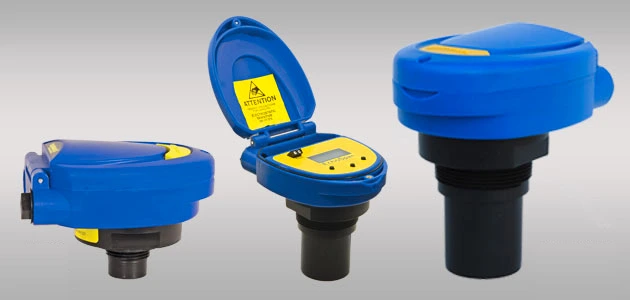
EchoSpan Ultrasonic Level Transmitter
General-purpose ultrasonic level transmitter with 1″/2″ NPT and flange-mount options.
Frequently Asked Questions
Is 316 stainless steel always safe for chemical service?
No — Flowline's own 285-chemical materials compatibility table rates 316SS as Corroded for 29 common chemicals, including sodium hydroxide, sulfuric acid, hydrofluoric acid, hydrogen peroxide, and hypochlorous acid. In nearly every one of those rows, PVDF or PTFE rates Excellent or Good instead.
Which Flowline sensor is rated for corrosive chemical service?
The LD33 pressure/submersible transmitter, with PTFE/FEP wetted material, is explicitly named for corrosive chemical service. The LU10 ultrasonic switch is the only intrinsically safe switch and is named for chemical, solvent, and light oil service.
What is the range of the Flowline LR85 radar level transmitter?
Up to 196.8 ft on solids or 393.7 ft on liquid, with a PFA-wetted antenna suited to low-dielectric-constant media — the longest range in the Flowline level transmitter line.
Get the right level sensor and wetted material for your chemistry
Ready to buy or need a fast answer? Call, text, or email James directly — (559) 395-5500 · [email protected].