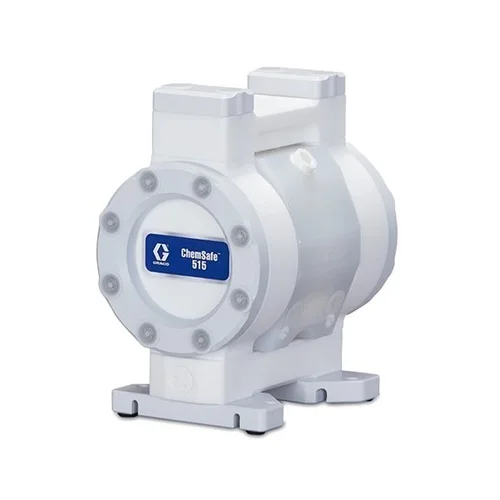
Diaphragm Pump — Acids
30+ years spec experience. Send James the process data and get a real answer — not a catalog page.
Request a Spec Review →Named chemicals
LibertyCES has documented Diaphragm Pump in Acids service, including Sulfuric Acid, Phosphoric Acid and Citric Acid. Wetted materials to confirm: PVDF, Noryl, Halar/ECTFE and PTFE. Documented models include Graco Husky/ChemSafe AODD and Filter Pump chambers. Compatibility depends on exact concentration, temperature and duty cycle, so confirm with a free spec review.
Notes from the vendor documentation
Griffco TIB2010-001 quantifies material failure thresholds for concentrated sulfuric acid across diaphragm-pump-adjacent hardware.
Materials documented for this service
- PVDF
- Noryl (fails >98.3% w/ SO3)
- Halar/ECTFE
- PTFE (one-piece flanged only)
- Alloy 20
Products cited for this service
Real Specifications
| Spec | Value | Source document |
|---|---|---|
| Griffco sulfuric acid material table | Noryl max 95% @200°F; PVDF max 95% @175°F; Halar (ECTFE) 100% @200°F; PTFE (one-piece flanged) 100% @200°F; Alloy 20 100% @300°F | Griffco Valve — Chemical Feed System Accessories |
| Filter Pump PS vertical pump acid service | 316 stainless steel, handles fatty/phosphoric/citric/lactic acids, operating range -30°F to 211°F (up to 250°F acceptable for non-caustic/non-hydrocarbon service) | Filter Pump — Full Product Line |
| Filter Pump filter chambers temperature limit | Reduce inorganic particulates from aqueous alkaline/acidic solutions up to 230°F (110°C) | Filter Pump — Full Product Line |
| Graco QUANTM i30 spec | 30 GPM (114 lpm) at up to 100 psi, self-priming, sealless electric diaphragm design | Graco — Diaphragm Pumps |
Griffco's own bulletin: PTFE's acid compatibility advantage only holds in one-piece flanged construction — threaded PTFE connections are prone to leak from cold flow, a real failure mode on any acid-service accessory sharing the same diaphragm-pump skid.
A diaphragm pump's wetted-material choice for concentrated sulfuric acid service has to track the same Griffco threshold data used to spec the back-pressure and relief valves on the same skid — Noryl and PVDF both fail past 98.3% concentration, so matching the diaphragm material alone without checking the accessory hardware just moves the failure point downstream.
Every material and product claim on this page traces to real, vendor-published documentation on file with LibertyCES. Chemical compatibility depends on exact concentration, temperature, and duty cycle — confirm current specifications with the manufacturer and request a spec review before final specification.
FAQ
Can Diaphragm Pump handle Acids?
Griffco TIB2010-001 quantifies material failure thresholds for concentrated sulfuric acid across diaphragm-pump-adjacent hardware.
What wetted materials should Diaphragm Pump use in Acids service?
Materials documented for this service: PVDF, Noryl (fails >98.3% w/ SO3), Halar/ECTFE, PTFE (one-piece flanged only), Alloy 20. Compatibility depends on exact concentration, temperature and duty cycle, so confirm with a spec review before final specification.
Which Acids chemicals does this cover?
Named chemicals in this documentation: Sulfuric Acid, Phosphoric Acid, Citric Acid, Lactic Acid, Fatty Acids.
Which Diaphragm Pump models are documented for Acids?
Documented examples include Graco Husky/ChemSafe AODD, Filter Pump chambers, Griffco pulsation dampener/back-pressure valve.
Ready to buy or need a fast answer? Call, text, or email James directly — (559) 395-5500 · [email protected].
Send James your spec
Fluid, concentration, temperature, flow or volume, and where it goes. James replies with a real answer, not a catalog page.
Reviewed by James Riggins, 30+ years specifying water and chemical process equipment · Updated