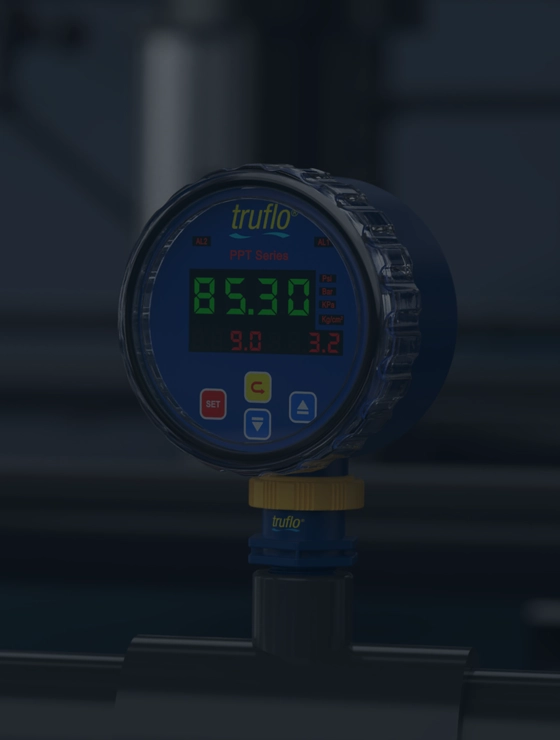
Pressure Instrument — Acids
30+ years spec experience. Send James the process data and get a real answer — not a catalog page.
Request a Spec Review →Named chemicals
LibertyCES has documented Pressure Instrument in Acids service, including Sulfuric Acid. Wetted materials to confirm: PTFE diaphragm and PVDF/PP/CPVC housing. Documented models include Plast-O-Matic Gauge Guard GGME/GGMU and Griffco Gauge & Instrument Guard. Compatibility depends on exact concentration, temperature and duty cycle, so confirm with a free spec review.
Notes from the vendor documentation
Gauge-guard diaphragm isolators consistently used to protect standard gauges from corrosive process fluid across three independent vendors.
Materials documented for this service
- PTFE diaphragm
- PVDF/PP/CPVC housing
Products cited for this service
Real Specifications
| Spec | Value | Source document |
|---|---|---|
| Plast-O-Matic gauge guard pressure range | Full vacuum to 250 PSI (200 PSI for GGME/GGMU) | Plast-O-Matic Valves — Gauge Guards |
| Plast-O-Matic diaphragm material | PTFE standard (0-30 PSI+); FKM for 0-15 PSI and vacuum | Plast-O-Matic Valves — Gauge Guards |
| Plast-O-Matic housing materials | PVC, CPVC (Corzan), Polypropylene, PVDF (Kynar) | Plast-O-Matic Valves — Gauge Guards |
| Griffco gauge guard tiers | Economy / Mid / Premium, in 316SS, CPVC, Hastelloy C | Griffco Valve — Chemical Feed System Accessories |
| Icon OBS gauge-guard accuracy | ±1.5% (vs ±0.75% for Icon's direct-diaphragm gauges) | Icon Process Controls — Pressure Gauges, Gauge Guards, Transmitters/Sensors |
| Icon OBS gauge-guard pressure range | 0-160 psi (most models) | Icon Process Controls — Pressure Gauges, Gauge Guards, Transmitters/Sensors |
A gauge guard trades accuracy for corrosion protection — Icon's own line shows isolated-diaphragm gauge-guard assemblies rated ±1.5% versus ±0.75% for their direct-diaphragm corrosion-resistant gauges, so specifying a gauge guard on a clean, non-corrosive service sacrifices accuracy for no real benefit.
Three independent vendors — Plast-O-Matic, Griffco, and Icon — converge on the same design pattern for acid pressure sensing: isolate a standard, cheap SS316/brass gauge movement behind a PTFE or FKM diaphragm rather than building the whole gauge from corrosion-resistant material. Most suppliers sell whichever gauge is in stock; Liberty CES matches the diaphragm material and pressure range to the acid concentration first, because the diaphragm — not the gauge body — is the only part actually touching the process fluid.
Every material and product claim on this page traces to real, vendor-published documentation on file with LibertyCES. Chemical compatibility depends on exact concentration, temperature, and duty cycle — confirm current specifications with the manufacturer and request a spec review before final specification.
FAQ
Can Pressure Instrument handle Acids?
Gauge-guard diaphragm isolators consistently used to protect standard gauges from corrosive process fluid across three independent vendors.
What wetted materials should Pressure Instrument use in Acids service?
Materials documented for this service: PTFE diaphragm, PVDF/PP/CPVC housing. Compatibility depends on exact concentration, temperature and duty cycle, so confirm with a spec review before final specification.
Which Acids chemicals does this cover?
Named chemicals in this documentation: Sulfuric Acid (general corrosive isolation).
Which Pressure Instrument models are documented for Acids?
Documented examples include Plast-O-Matic Gauge Guard GGME/GGMU, Griffco Gauge & Instrument Guard, Icon OBS Gauge Guard.
Ready to buy or need a fast answer? Call, text, or email James directly — (559) 395-5500 · [email protected].
Send James your spec
Fluid, concentration, temperature, flow or volume, and where it goes. James replies with a real answer, not a catalog page.
Reviewed by James Riggins, 30+ years specifying water and chemical process equipment · Updated