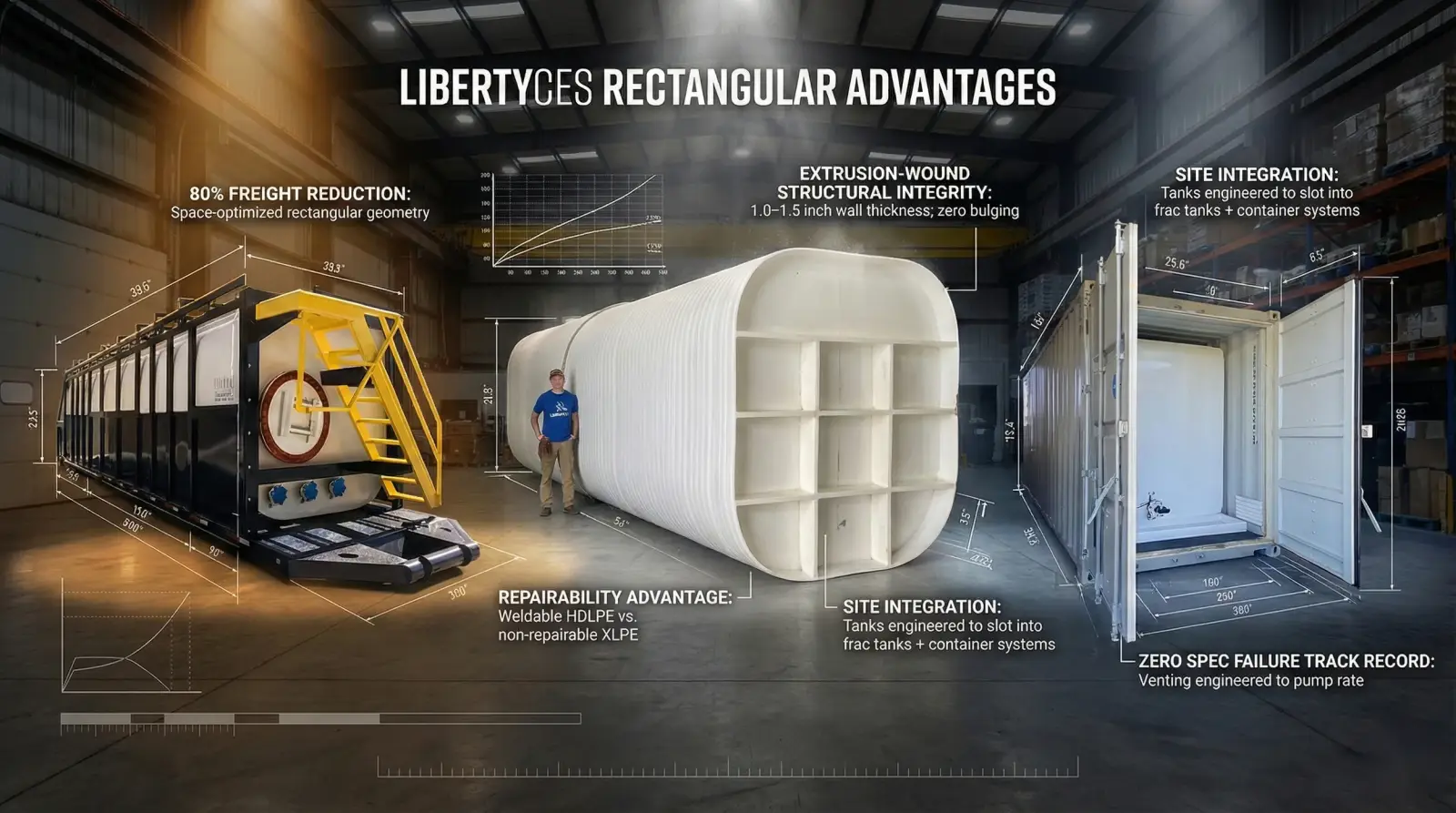
Rectangular Chemical Storage Tanks
Stop Shipping Air
Rectangular HDPE & polypropylene tanks engineered by James Riggins to fit where cylinders can't — inside shipping containers, frac tanks, and tight plants. Up to 18,000 gallons in a rectangular footprint, extrusion-wound walls that don't bulge, and freight savings up to 80% on day one.
By James Riggins, Lead Engineer, Liberty Chemical & Equipment Supply, Inc.
30+ years spec experience. Send James the process data and get a real answer — not a catalog page.
Request a Spec Review →The Riggins Multiplier: Rectangular Tanks That Pay for Themselves Day One
Most plastic tank “problems” are not material problems — they're geometry and spec problems. Round tanks waste space in square footprints. Rectangular geometry engineered to cut freight costs by up to 80% versus comparable cylindrical tanks, while maximizing volume inside standard containers, trailers, frac tanks, and tight mechanical rooms.
- Fits 20' & 40' Shipping Containers
- Extrusion-Wound HDPE & PP — No External Cages
- Field-Repairable, Field-Weldable Designs
- 110% Double-Wall “Tank-in-a-Tank” Containment
Rectangular tank lines LibertyCES specifies
8 published product lines from 3 manufacturers, from 2 to 18,000 gallons (8–68,137 L). Each row links to the manufacturer document it comes from. For a specific capacity, use the tank size finder.
| Manufacturer & line | Capacity | Material | Rated SG | Temperature | Source document |
|---|---|---|---|---|---|
| Houston PolyTank Patented Extrusion-Wound Rectangular Tank | up to 18,000 gal 68,137 L | PP or HDPE | Houston PolyTank product catalog, pp. 9-10 | ||
| Peabody Engineering Fiberglass Rectangular Process Tanks - Open Top — FRP Open Top Rectangular Tanks | 50–955 gal 189–3,615 L | Polyester or Vinylester | Peabody Engineering, LLC — General Product Catalog (July 2026 Edition) | ||
| Peabody Engineering Fiberglass Rectangular Process Tanks - Closed Top — FRP Closed Top Rectangular Tanks | 50–955 gal 189–3,615 L | Polyester or Vinylester | Peabody Engineering, LLC — General Product Catalog (July 2026 Edition) | ||
| Ace Roto-Mold Low Profile Rectangle Tanks | 50–500 gal 189–1,893 L | Ace Roto-Mold (a division of Den Hartog Industries, Inc.) — General Product Catalog… | |||
| Peabody Engineering Gemini Dual Containment Square — Gemini Squaredouble wall | 5–440 gal 19–1,666 L | LPE or XLPE, PPL/PVDF avail | Peabody Engineering, LLC — General Product Catalog (July 2026 Edition) | ||
| Peabody Engineering ProChem Rectangular Tanks | 13–330 gal 49–1,249 L | LPE 1.0/1.5 std, XLPE/PPL/PVDF avail | to 1.50 | Peabody Engineering, LLC — General Product Catalog (July 2026 Edition) | |
| Peabody Engineering ProChem Open Top Rectangular Tanks | 2–180 gal 8–681 L | LPE | Peabody Engineering, LLC — General Product Catalog (July 2026 Edition) | ||
| Peabody Engineering ProChem Square Tank | 140 gal 530 L | LPE 1.5/1.9, XLPE 1.9 | to 1.90 | Peabody Engineering, LLC — General Product Catalog (July 2026 Edition) |
Frequently Asked Questions
Why choose a rectangular tank instead of a cylindrical tank?
Rectangular geometry fits where cylinders can't — inside shipping containers, frac tanks, and tight plants — while maximizing volume utilization and cutting freight costs by up to 80% versus comparable cylindrical tanks.
What's the maximum capacity for a rectangular tank?
Typically up to 18,000 gallons in a rectangular footprint, engineered with extrusion-wound walls that don't bulge under repeated fill-and-drain cycles.
Do rectangular tanks fit standard shipping containers?
Yes — rectangular tanks are commonly engineered to fit inside 20' and 40' shipping containers, a key advantage for facilities needing containerized or mobile chemical storage.
Get your tank spec'd against real chemistry, not guesswork
Send LibertyCES the chemical, concentration, temperature, and duty cycle — we'll help match resin, wall thickness, fittings, and containment.
Ready to buy or need a fast answer? Call, text, or email James directly — (559) 395-5500 · [email protected].
Related Guides & Products
Send James your spec
Fluid, concentration, temperature, flow or volume, and where it goes. James replies with a real answer, not a catalog page.
Reviewed by James Riggins, 30+ years specifying water and chemical process equipment · Updated