
Asahi America Thermoplastic Valves: Material Selection, Valve Types, and Chemical-Service Specs
Asahi/America manufactures thermoplastic valves for corrosive chemical service, water treatment, wastewater, industrial process lines, and high-purity fluid handling. LibertyCES helps you select the correct Asahi valve body, elastomer, seat, seal, diaphragm, connection style, and actuation package before the wrong material becomes a maintenance problem.
Which Asahi Thermoplastic Valve Should You Use?
The wrong Asahi valve is usually not wrong because of the brand. It is wrong because the material package does not match the service. A thermoplastic valve spec is not finished when you choose PVC, CPVC, PP, or PVDF.
| Application | Best Starting Point |
|---|---|
| Clean on/off chemical isolation | Type-21/21a true-union ball valve |
| Sodium hypochlorite / off-gassing chemical service | Vented ball valve or Type-14 diaphragm valve depending on duty |
| Slurries, suspended solids, abrasive media | Diaphragm valve |
| Large-diameter moderate flow control | Type-57P or Type-75 butterfly valve |
| Backflow prevention | Check valve |
| Automated chemical feed or plant control | Actuated ball, butterfly, or diaphragm valve |
| High-purity / semiconductor / pharmaceutical fluid | PVDF, PP, PFA, or PTFE-wetted specialty valve depending on purity and chemical requirements |
Why Thermoplastic Valves Matter in Chemical Service
Metal valves are not automatically the best answer for corrosive chemical systems. In many water-treatment, wastewater, chemical-feed, high-purity, and industrial process applications, thermoplastic valves can reduce corrosion risk, lower maintenance burden, and keep the wetted flow path compatible with aggressive media.

Corrosion Resistance
Thermoplastic valve bodies can resist many corrosive chemicals that attack metals, especially in water treatment, wastewater, chemical feed, and industrial process systems.
Non-Wetted Metal Isolation
Many thermoplastic valve designs isolate metal components from the wetted flow path, reducing corrosion exposure inside aggressive chemical service.
Maintenance Access
True-union designs and modular valve bodies can simplify service, removal, and replacement without rebuilding adjacent piping.
Material Specificity
PVC, CPVC, PP, and PVDF are not interchangeable. EPDM, FKM, PTFE, AFLAS, and composite diaphragms are not interchangeable either.
PVC vs CPVC vs PP vs PVDF: Asahi Valve Body Material Selection
The first spec decision is the valve body material. The body must match the chemical, concentration, temperature, pressure, installation method, and pipe system. Do not choose PVC, CPVC, PP, or PVDF by habit.
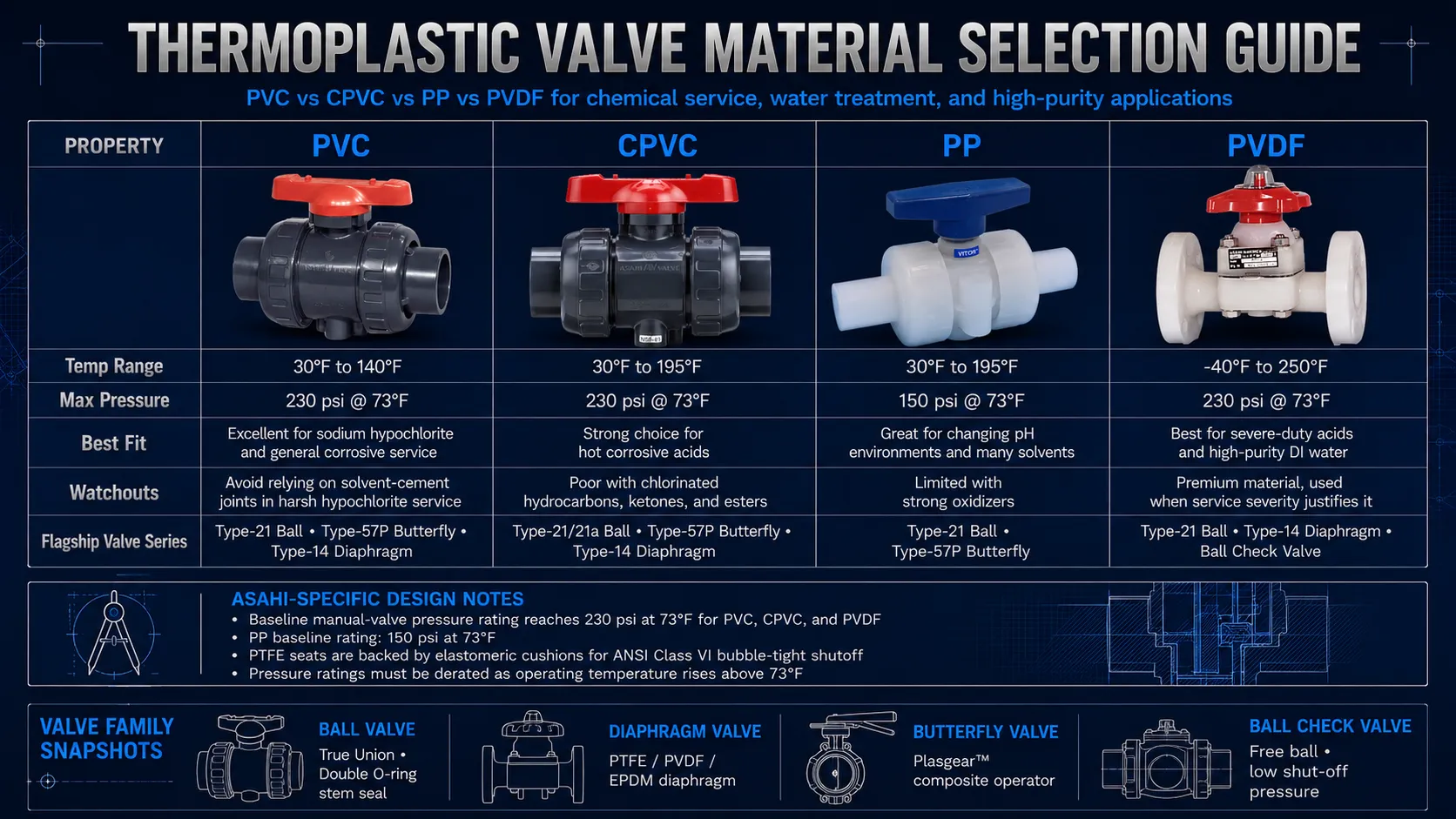
| Material | Best Fit | Watch-Outs | Practical Spec Note |
|---|---|---|---|
| PVC | Economical choice for many water, mild acid, alkali, brine, and general chemical services | Not for freezing service, many solvents, ketones, esters, aromatics, or chlorinated hydrocarbons | Good first screen for many water-treatment systems |
| CPVC | Higher-temperature corrosive liquids and hot-water service compared with PVC | Limited resistance to amines and many chlorinated or aromatic hydrocarbons | Consider when PVC temperature range is not enough |
| PP | Acids, strong alkalis, solvents, variable pH waste streams | Poorer fit for strong oxidizers, chlorinated hydrocarbons, hot concentrated nitric acid, and halogens | Often attractive where heat fusion and broad chemical resistance are needed |
| PVDF | Premium fluoropolymer for high-purity, aggressive chemical, acid, halogen, and hot corrosive service | Not universal; verify caustic and extreme chemical limits | Strong option when PVC, CPVC, or PP are not enough |
Asahi Thermoplastic Valve Types: Ball, Diaphragm, Butterfly, Check, and Gate
Asahi/America thermoplastic valve selection starts with function. Isolation, throttling, slurry handling, backflow prevention, chemical feed control, and actuation all point to different valve families.
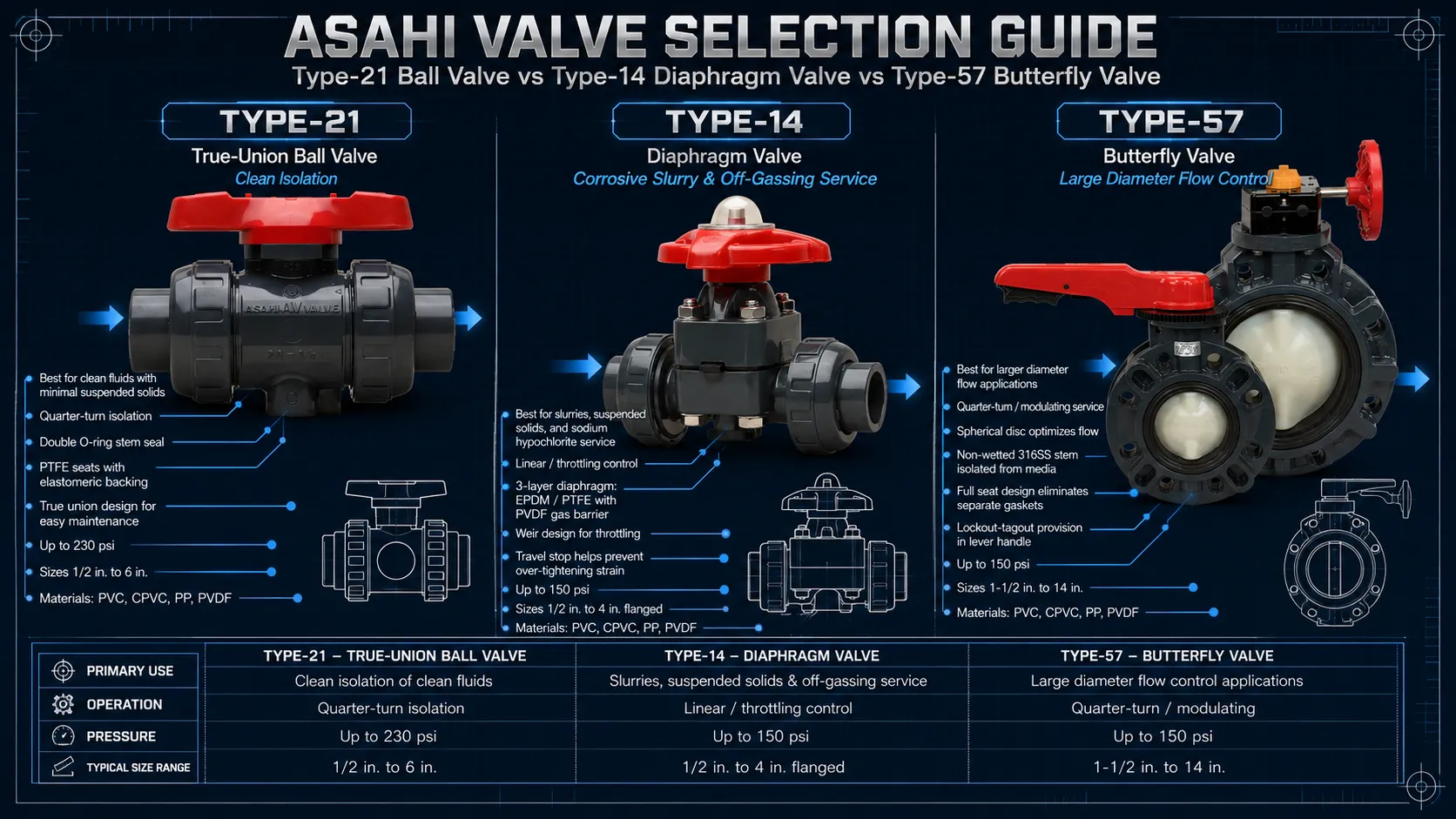
Type-21/21a Ball Valves
Asahi Type-21/21a true-union ball valves are quarter-turn valves used for clean on/off service in chemical, water-treatment, wastewater, and industrial systems. The true-union design matters because the valve body can be removed from the piping system without cutting or rebuilding adjacent pipe.
- Best for clean on/off isolation
- Available in PVC, CPVC, PP, and PVDF bodies
- PTFE seats with EPDM or FKM backing
- EPDM, FKM, or AFLAS seal options
- Options include locking handles, limit switches, and vented ball configurations
Type-14 Diaphragm Valves
Asahi Type-14 diaphragm valves are used when the service is more demanding than simple clean on/off isolation. They are a strong fit for corrosive chemical service, slurries, suspended solids, abrasive media, and aggressive off-gassing chemicals.
- Strong for aggressive chemical service
- Good for slurries and suspended particles
- Weir-style diaphragm design
- PTFE diaphragm options
- Composite diaphragm options for off-gassing chemical service
Type-57P Butterfly Valves
Asahi Type-57P butterfly valves are used for larger-diameter lines where moderate flow control, on/off service, or modulating service is needed. They are especially relevant where a compact, corrosion-resistant valve is needed in larger pipe sizes.
- Quarter-turn operation
- Moderate flow control
- Larger-diameter service
- Good suspended-solids tolerance
- Not the first choice for heavy slurry or debris
Check Valves and Specialty Flow Control
Asahi thermoplastic check valves should be positioned around automatic backflow prevention in chemical and water systems. They round out the full valve package for chemical feed, transfer, drain, and process piping systems.
- Backflow prevention
- Foot valve and spring-loaded configurations
- Thermoplastic body options
- Seat and seal material selection still matters
EPDM, FKM, PTFE, AFLAS, and Composite Diaphragms in Asahi Valve Specs
A thermoplastic body can be compatible while the elastomer fails. That is why Asahi valve selection should include the valve body, seat, seal, O-ring, diaphragm, and any backing or cushion material.
| Material | Common Asahi Valve Role | Best-Fit Framing | Watch-Out |
|---|---|---|---|
| EPDM | Seals, O-rings, diaphragm backing | Water, caustic, many aqueous services | Poor in oils, fuels, hydrocarbons |
| FKM | Seals, O-rings, backing cushions | Hydrocarbons, fuels, oils, many solvents | Not universal for caustic, steam, or bleach service |
| PTFE | Seats, liners, diaphragm wetted face | Broad chemical resistance, aggressive chemicals, high purity | Needs support/backing in some valve constructions |
| AFLAS | Specialty seal option | Specialty chemical/temperature applications | Must verify chemical and temperature compatibility |
| PTFE/PVDF/EPDM Composite | Diaphragm construction | Sodium hypochlorite and off-gassing service | Must match exact manufacturer configuration |
Buna-N vs EPDM vs FKM vs PTFE
PTFE diaphragms for chemical processing
Asahi Valve Selection for Sodium Hypochlorite Service
Sodium hypochlorite service needs more than a generic chemical compatibility check. It can involve oxidizer attack, off-gassing, trapped valve-cavity pressure, elastomer degradation, diaphragm gas migration, and weak connection details.
For Asahi valves, sodium hypochlorite selection should compare the full configuration, not one material name.
Compare the Valve Type
- Vented ball valve vs diaphragm valve
- Isolation vs control duty
- Clean service vs off-gassing or aggressive service
- Manual vs actuated operation
Compare the Material Package
- PVC vs CPVC body
- FKM O-rings and seals
- PTFE seats backed with FKM
- PTFE/PVDF/EPDM diaphragm construction
- Flanged or non-cemented connection strategy
- Concentration and temperature
Sodium hypochlorite is not the place to guess.
Send LibertyCES the concentration, temperature, pressure, valve type, body material, seat, seal, diaphragm, connection style, and failure history.
Run a Hypochlorite Valve Spec CheckManual, Pneumatic, and Electric Actuated Asahi Valves
Many Asahi valve applications begin as manual valve selections, then move into pneumatic or electric actuation when the system needs automated open/close control, modulation, remote monitoring, or integration with plant control systems.
Manual Valves
Best for simple operator-controlled isolation, maintenance valves, drains, and low-frequency use.
Pneumatic Actuation
Best for fast open/close cycling, chemical feed systems, and systems with plant air available.
Electric Actuation
Best for remote operation, slower controlled movement, automation panels, and systems where plant air is not available.
Monitoring and Accessories
Limit switches, locking handles, position indication, fail position, and safety accessories should be selected with the process and control system in mind.
Where Asahi Thermoplastic Valves Fit
| Application | Likely Valve Direction | Spec Concern |
|---|---|---|
| Water treatment chemical feed | Ball, diaphragm, check | Hypochlorite, caustic, acid, fluoride compatibility |
| Wastewater systems | Ball, butterfly, diaphragm, check | Solids, abrasion, corrosion, backflow |
| Sodium hypochlorite systems | Vented ball or diaphragm | Off-gassing, elastomers, diaphragm layers |
| Caustic soda | Ball or diaphragm | EPDM/FKM choice, CPVC stress-cracking risk |
| Acid feed | Ball or diaphragm | Body material, PTFE seat/diaphragm, temperature |
| High-purity water | PVDF, PP, PFA/PTFE specialty valves | Contamination, leaching, purity |
| Industrial chemical transfer | Ball, butterfly, check | Chemical family, pressure, temperature |
| Automated chemical systems | Actuated ball, butterfly, diaphragm | Control signal, cycle frequency, fail position |
How to Specify an Asahi Thermoplastic Valve
Before selecting an Asahi valve, do not start with the model number. Start with the service conditions.
Common Asahi Thermoplastic Valve Specification Mistakes
Choosing the Body but Ignoring the Elastomer
A PVC or PVDF valve body can survive while the O-ring, seat backing, seal, or diaphragm fails.
Treating PVC, CPVC, PP, and PVDF as Interchangeable
Each thermoplastic has a different chemical and temperature envelope. The body material has to be matched to the application.
Using a Ball Valve Where a Diaphragm Valve Belongs
Ball valves are excellent for clean on/off service. Diaphragm valves are often better for aggressive chemicals, slurries, abrasive service, and off-gassing concerns.
Ignoring Sodium Hypochlorite Off-Gassing
Hypochlorite service may require vented ball valves or PTFE/PVDF/EPDM diaphragm construction.
Adding Actuation After the Valve Is Already Wrong
Actuation does not fix a bad valve spec. Automating the wrong valve only repeats the same failure faster.
Skipping Connection Style
Socket, threaded, flanged, true-union, fusion, and specialty connector styles can change the risk profile of the full valve assembly.
Get an Asahi Thermoplastic Valve Spec Check
If you are not sure which Asahi valve belongs in the system, send LibertyCES the application details before ordering.
We Help You Review
- Valve type
- Body material
- Seat material
- Seal/O-ring material
- Diaphragm construction
- Connection style
- Manual vs actuated operation
- Chemical compatibility risk
- Temperature and pressure limits
When It Matters Most
This is especially important when sodium hypochlorite, caustic, acids, solvents, off-gassing chemicals, high-purity systems, or actuated process valves are involved.
Asahi makes the platform. LibertyCES helps confirm the spec.
Send the chemical name, concentration, temperature, pressure, pipe size, valve function, body material, seat material, seal material, diaphragm construction, connection style, and actuation requirements.
Check My Asahi Valve SpecAsahi America Thermoplastic Valve FAQ
What are Asahi America thermoplastic valves used for?
Which Asahi valve is best for on/off chemical isolation?
Which Asahi valve is best for sodium hypochlorite?
What is the difference between PVC, CPVC, PP, and PVDF valves?
Are Asahi valves available with pneumatic or electric actuation?
Why does elastomer selection matter in Asahi valve specs?
Can LibertyCES help select the correct Asahi valve?
Need the Right Asahi Valve? Send the Chemistry First.
Asahi/America manufactures the thermoplastic valve platform. LibertyCES helps you select the correct configuration for the application.
Send us the chemical name, concentration, temperature, pressure, pipe size, valve function, body material, seat material, seal material, diaphragm construction, connection style, and actuation requirements.
We will help you narrow the correct Asahi valve type, material package, and spec path before a wrong material choice turns into another maintenance problem.