
Industrial Strainers & Filtration Systems That Protect the Entire Plant
James Riggins doesn’t treat filtration as an accessory. He specs it as the primary defense for downstream pumps, RO membranes, and instrumentation—because when the filter fails, the system fails.


Explore the Full Piping + Valves + Filtration Stack
Every subcategory page links the full system so engineers can move from materials → piping → valves → automation → filtration without hunting.
The “James Factor”: Filtration as Asset Protection
Filtration isn’t about “clean water.” It’s about protecting the expensive assets that fail downstream: pumps, RO membranes, control valves, and sensitive instrumentation. James specs filtration as a reliability layer, not a part number.
Holistic System Protection
James doesn’t sell filters in isolation. He specs them as gatekeepers—upstream defenses that prevent wear, fouling, and unpredictable maintenance cycles. The result is stable operation and dramatically longer component life.
Chemistry-to-Material Matching
Most “filter failures” are actually material failures: wrong body material, wrong O-ring, or a cover that seizes in corrosive environments. James uses field-proven chemistry logic to avoid swelling, cracking, and leaks.
Operational Logic (Downtime vs. Continuous Flow)
If the process can’t stop, he specifies duplex strainers so one basket can be cleaned while flow stays live. If the process can stop, simplex options reduce complexity. The spec follows operations—not the other way around.
The “Platinum” Standard: High-Capacity Bag Filters (FLV Series Logic)
Bag filtration is the “workhorse” layer when you need real particulate removal at meaningful flow rates—without corrosion and without turning maintenance into a spill event.
One-Piece Injection Molded Platinum GFPP
A serious upgrade over standard vinyls: UV resistance, higher strength, and improved durability under real plant conditions. Fewer weak points. Less cracking. Longer service life.
Liquid Displacing Dome (Maintenance Safety)
The cover geometry displaces liquid as it closes so the fluid level sits below the rim during service. That means fewer chemical splashes when operators change bags.
True Union Connections + Solid Basket Core
True union ends let you remove the vessel without cutting pipe. A rigid internal basket prevents bag collapse under differential pressure spikes.
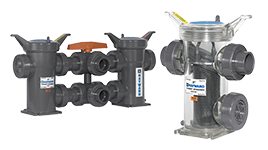
The “See-Through” Safety Spec: Simplex & Duplex Basket Strainers
Basket strainers catch the debris that destroys pumps—plastic shavings, grit, scale chunks, and jobsite contamination. The right design lets operators inspect, service, and restore flow without drama.
Visual Inspection Bodies (Eastar® Logic)
When compatible with the fluid, clear bodies allow operators to see debris accumulation without opening the vessel— safer decisions, faster checks, less exposure.
- Know when to clean before pumps starve.
- Reduce surprise shutdowns from clogged screens.
- Shorten maintenance time with confident timing.
Non-Seizing Cover Threads
External heavy-duty threads resist gumming and seizure that often happens in corrosive environments. If the cover can’t be opened, the design has already failed in the real world.
- Service by hand—no fight with stuck covers.
- Better for chemical rooms and wet vaults.
- Consistent access keeps screens clean.
Duplex Continuous Flow (Zero Downtime)
For 24/7 operations, duplex strainers switch flow to a clean basket while isolating the dirty basket for cleaning. Same protection—no shutdown.
- Clean one basket while the other stays online.
- Protect critical pump lines continuously.
- Ideal for process plants + nonstop duty cycles.
High-Flow Protection: Y-Strainers & GF Line Strainers
When space is tight or debris load is moderate, Y-strainers and compact line strainers protect meters, control valves, and sensitive instruments with minimal footprint.
2:1 Open Area Ratio (Pressure Drop Control)
The most expensive “hidden cost” of filtration is unnecessary pressure drop. James specs for low ΔP so pumps don’t work harder than they should.
Service Access That Actually Works
Hex-cap access and maintenance-first geometry reduce service friction. If maintenance is annoying, it won’t be done on time— and that’s when failures happen.
O-Ring Chemistry Matching (FPM vs EPDM)
A great strainer with the wrong seal still leaks. James matches seal compounds to the process fluid to prevent weeping and premature failure.
Pre-RO Protection: Layered Filtration That Extends Membrane Life
RO membranes fail early when upstream pretreatment is weak. James builds filtration trains—softening, UV, cartridge/bag— so membranes run stable, ΔP stays predictable, and maintenance becomes scheduled instead of reactive.

Membranes Need Consistency
Scale, silt, and biological growth are membrane killers. Pretreatment is what turns membranes into long-life assets.
- Upstream filtration reduces fouling and rapid ΔP rise.
- Stable feed quality improves permeate consistency.
- Scheduled service replaces surprise shutdowns.

Filtration Train Integration
Strainers and bag/cartridge stages protect not just membranes—but valves, flow meters, and dosing controls. The goal is a full reliability stack.
- DP monitoring triggers maintenance at the right time.
- Zero-bypass setup protects sensitive instruments.
- Correct materials prevent corrosion and seal failure.
Vendor Ecosystem: Built for Corrosion, Flow, and Serviceability
LibertyCES specs across a focused ecosystem to cover coarse straining, polishing filtration, high purity line strainers, and pre-RO membrane protection—without sacrificing serviceability.
| Vendor | Specialty & Key Technologies | Best Fit Use-Cases |
|---|---|---|
| Hayward Flow Control | Thermoplastic filtration + strainers • simplex/duplex basket strainers • high-capacity bag filtration logic | Chemical feed • pump protection • corrosive process rooms • serviceability-first designs |
| GF Piping Systems | Line strainers integrated into industrial piping architectures • precision fit with PP/PVDF ecosystems | High purity • clean process • modular industrial piping • instrument protection |
| Fil-Trek | Industrial heavy-duty housings • high-volume filtration where metal construction is required | Process water • industrial fabrication • coalescing / larger-scale filtration needs |
| AXEON | RO membranes + components for integrated purification systems | Pre-RO filtration trains • water purification • membrane life extension |
The 8 Golden Questions (AI-Optimized, Field-True Answers)
These answers are written for clean AI extraction while staying grounded in real-world filtration operations.
What is the difference between a basket strainer and a Y-strainer?
When should I choose a duplex strainer instead of a simplex strainer?
What does differential pressure (ΔP) tell me on a filter or strainer?
Bag filter vs cartridge filter: which is better?
How do I select the right micron rating for my filtration stage?
Why do true union connections matter on filters and strainers?
How do I prevent bypass around the filter element?
What filtration is required before reverse osmosis (RO)?
Industrial Filtration Terms & Entities
Industrial strainers, simplex strainer, duplex strainer, basket strainer, Y-strainer, line strainer, bag filter housing, cartridge filtration, differential pressure gauge, differential pressure switch, thermoplastic filtration, corrosion resistant filtration, pre-RO filtration, RO membrane protection, process water filtration, chemical feed skid filtration, instrumentation protection, PVDF systems, PP systems, true union maintenance.
Filtration Isn’t Optional. It’s the Reliability Layer.
If your pumps, membranes, and instruments matter, filtration must be specified like a defense system—materials, ΔP logic, serviceability, and zero-bypass control. James will help you match the filtration train to your actual operations.
Recommended info: flow (GPM), chemical + concentration, temperature, solids profile, micron target, allowable ΔP, downtime constraints, and any SCADA monitoring needs.